
Learn About Heisey Glass
About Heisey Glass
A.H. Heisey & Company produced fine glassware in Newark, Ohio, from 1896 to 1957. The items made by Heisey and their many different patterns, colors, etchings, and cuttings reflect the changes in tastes and lifestyles over more than 60 years, from the Victorian era to Mid-Century Modern.
Patterns
The designs of Heisey’s glass patterns tell the story of American tastes and lifestyles from the late 19th century to the Roaring Twenties to the Great Depression to World War II to the post-war era and the beginning of the Space Age.
The intricate patterns of Heisey’s early years, such as Nos. 1201 Fandango, 1205 Fancy Loop and 1255 Pineapple and Fan, imitated the “brilliant” cut glass of the period.
This style soon gave way to the simple but elegant Colonial style glass. Patterns in this style dominated Heisey’s production until the 1920s, and Colonial style glass was made until the company closed in 1957.
Social changes after World War I were reflected in the glassware of the time, which was less formal and often incorporated Art Deco designs. The No. 1252 Twist pattern, made in several colors, exemplifies this period.
Heisey met the challenge of the Great Depression with the No. 1401 Empress pattern with its fan motif and dolphin feet. After the repeal of Prohibition, stemware patterns multiplied, featuring intricate pressed stems and blown bowls embellished with etchings and sparkling cuttings.
In the difficult war years of the 1940s, Heisey went back to basics, focusing on pressed tableware patterns in Crystal, such as Nos. 1469 Ridgeleigh, 1503 Crystolite, and 1540 Lariat. After the war’s end, Heisey sought to provide glassware for the more casual suburban lifestyle with new patterns. Simpler and less formal designs such as Nos. 1567 Plantation and 1951 Cabochon replaced many of the tableware and stemware patterns of the pre-war era.
In the 1950s, Heisey hired renowned designer Eva Zeisel, who created several patterns with a distinctly “modern” flair, Nos. 1637A Town and Country, 6006 Hourglass, 6007A Crystal Buds, and 6009A Roundelay. Perhaps inspired by the beginning of the “space race,” Heisey’s last major patterns, Nos. 1626 Satellite and 1632 Lodestar, featured a base in the shape of a large five-pointed star.
Examples of Heisey’s patterns from the 1890s to the 1950s are on display in chronological order in Gallery One.
Colors
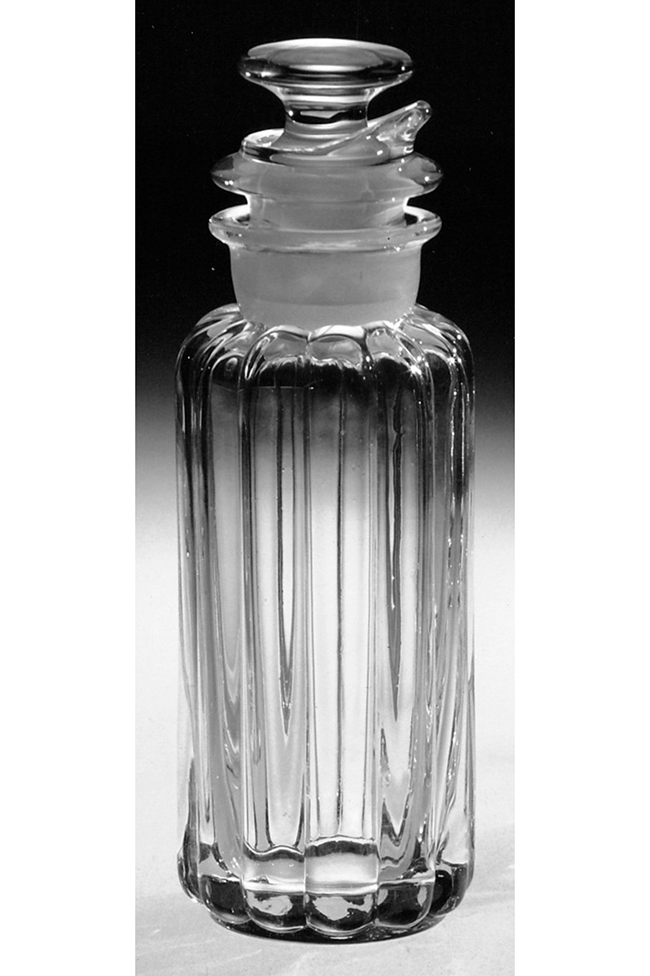
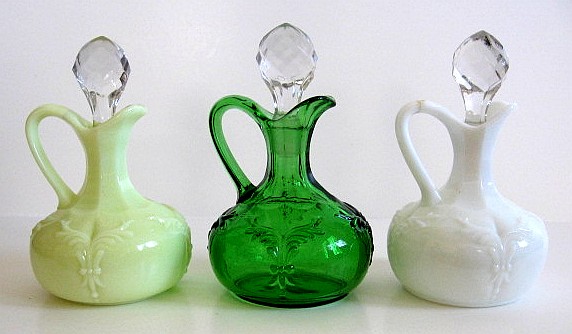
If any “color” defines Heisey glass, it is the clear colorless glass that Heisey called Crystal. Heisey was justifiably proud of its sparkling clarity, and almost everything Heisey made was available in Crystal. Heisey also produced glassware in an array of attractive colors. Colors made in the company’s early years were typical of the period and included Canary, or “Vaseline glass,” a rich shade of green called Emerald, and two opaque colors, Opal, or milk glass, and Ivorina Verde, an opaque yellow commonly called “custard glass.”
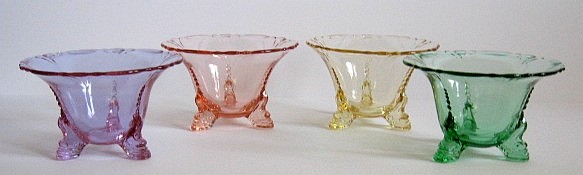
Crystal predominated until the mid-1920s, when colored glass became popular. Heisey responded to this trend by developing and producing a veritable rainbow of colors, including Moongleam (a pastel green), Flamingo (pink), Hawthorne (lavender), Marigold (a deep yellow), Sahara (a pastel yellow), Alexandrite (lavender), Stiegel Blue, also known as Cobalt (a deep blue), Tangerine (orange), and Zircon (blue-green).
Heisey also produced glassware in Amber beginning in the 1920s and continuing until the 1950s. Much of Heisey’s Amber glass was made for use in the Harvey House restaurants and railroad dining cars. Some of Heisey’s animal figurines were made in a light Amber shade, called “Honey Amber” by collectors.
As the 1930s drew to a close, the popularity of colored glass faded, and the threat of war caused some chemicals used in making colored glass to become scarce or unavailable. Crystal again became the mainstay of Heisey’s production. In the 1950s, Heisey brought back Zircon, renaming it Limelight. The company also introduced Sultana (a darker shade of Amber) and Dawn (charcoal).
Examples of all of the colors produced by Heisey are on display in the front parlors of the King House.
Etchings and Carvings
The second decade of the 20th century was a time of change for the American glass industry and for A.H. Heisey & Company. The era of “brilliant” cut glass was ending, and intricate pressed patterns imitating cut glass were no longer in demand. In their place, Heisey began producing blown wares embellished with dainty etchings, described in the company’s advertisements as “lacy etchings of frost on a window” and “gossamer tracery like rare old lace.” This etching style was used throughout the company’s history, culminating in Heisey’s most popular etching, No. 507 Orchid, produced from 1940 to 1957. In some etchings, the lacy design surrounded medallions called “cameos” that featured images of the Pied Piper, Trojan warriors, Diana the Huntress, and others.
When colored glass was popular in the 1920s and ’30s, etchings, often accompanied by visual effects known as “optics,” enhanced the appeal of Heisey colors like Flamingo, Moongleam, and Sahara.
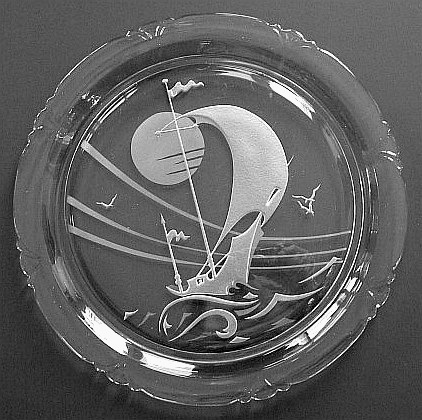
Always innovative, Heisey developed a new etching technique known as “deep plate etching” or “silhouette etching” in the 1930s. In a departure from the lacy designs of earlier etchings, deep plate etchings featured larger figures, such as circus scenes, horses and riders, sailboats and motorboats, sports motifs, and even mermaids. Often found on barware such as highball or soda glasses, cocktail shakers, cocktail glasses, and decanters, deep plate etchings are popular with today’s collectors.
Carvings have an appearance similar to Heisey’s deep plate etchings but are produced by sandblasting, an entirely different process. Heisey first produced glassware decorated with carvings in 1934, with some production continuing until 1944. Many of the Heisey carvings had Art Deco style designs and were very popular. Like the deep plate etchings, carvings are most often found on barware. Carvings by glass artists, including Dorothy Thorpe and Frank Oda, are also known on Heisey glassware.
Many examples of Heisey’s fine etchings and carvings are displayed throughout the museum.
Cuttings and Engravings
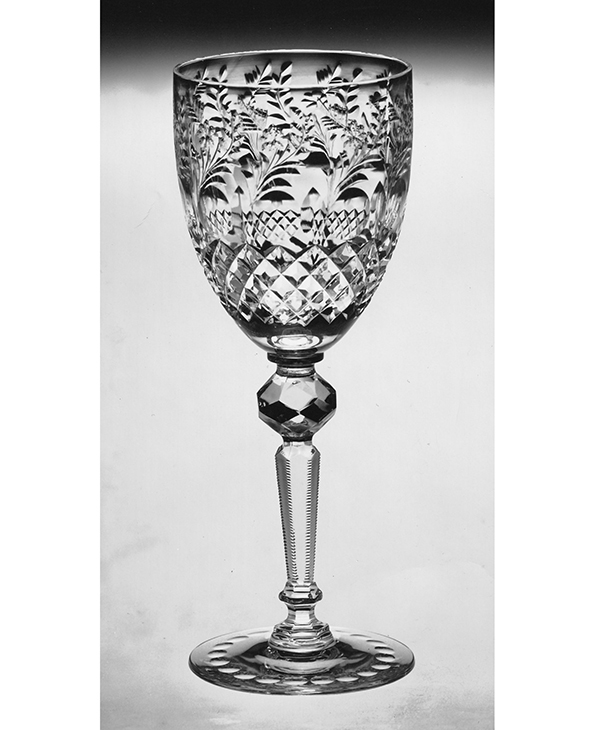
Beginning in around 1916, Heisey enhanced the beauty of its glassware with attractive cuttings executed by skilled glass cutters in the Heisey factory. The first cuttings were done on baskets, but the company soon expanded its offerings to make cuttings available on a wide variety of wares. The most popular cutting of the period, No. 679 Windsor, was offered on almost 60 patterns and could be found on items including stemware, cream and sugar sets, comports, vases, colognes, and jugs, among many others. More than 100 cuttings were designed and introduced between 1916 and 1924.
After closing in the late 1920s, the cutting department reopened in 1932. At around the same time, Heisey hired master cutter and engraver Emil Krall, Sr. as head designer. He later became the head of the cutting and engraving department. During his tenure at Heisey, Krall designed more than 100 production cuttings and engravings. Many of the cuttings of this era were highly polished “Rock Crystal” cuttings that greatly enhanced the sparkle of Heisey’s Crystal stemware and other pieces. Krall also produced one-of-a-kind presentation pieces with elaborate cuttings and engravings. Krall left Heisey to establish his own cutting shop in the early 1940s.
Because of the lack of skilled workers, production of cuttings lagged during the World War II years. The postwar period saw the introduction of many new stemware lines and new cuttings to embellish them. These were often less elaborate and more “modern” in style than the cuttings of earlier decades. Several cuttings were designed to complement dinnerware patterns of the time.
A display of most of Heisey’s production cuttings on goblets can be viewed in the King House at the Heisey Glass Museum.
Glass Animals
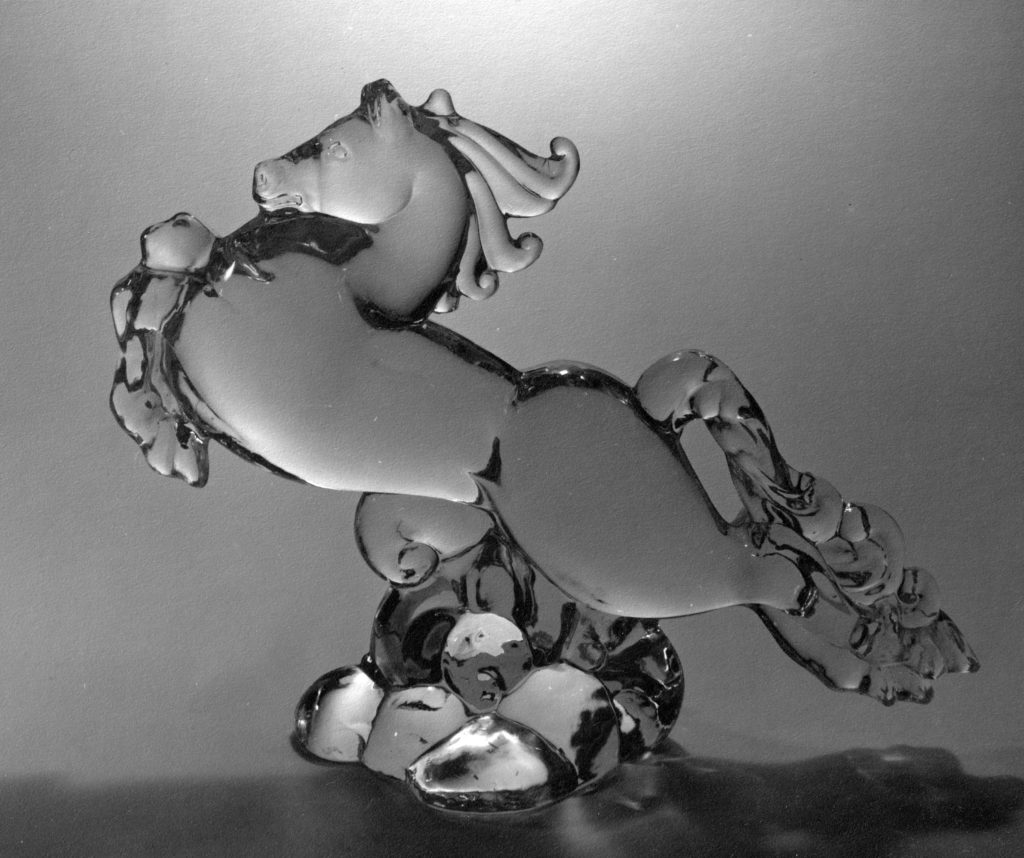
Beginning in 1940, Heisey introduced a series of animal figurines that became favorites of collectors in later years. Often advertised in ensembles with other Heisey glassware, they helped sustain the company’s business during the difficult post-war years. From the tiny Chicks to the spectacular Flying Mare, the figurines came from all corners of the animal kingdom: barnyard and farm animals, family pets, birds, inhabitants of the African savannas, sea creatures, and many horses.
How Heisey Glass Was Made
Skilled glass workers at the Dalzell-Viking Glass Company make a Flying Mare figurine using the original Heisey mould and techniques used by the workers at the Heisey factory.
Frequently Asked Questions
What is Heisey glass?
It is fine American-made glassware, made by A.H. Heisey & Company in Newark, Ohio, from 1896 to 1957. Heisey made both pressed and blown glass. Unlike the free-blown glass you may have seen in glass-blowing demonstrations, Heisey’s blown glass was blown into a mould. Some pieces have both pressed and blown elements, such as a piece of stemware with a blown bowl and a pressed stem with an intricate pattern.
Is Heisey glass crystal?
Heisey made some leaded glass, but most Heisey glass is not “lead crystal” as that term is used today. Heisey and other glassmakers of the period used the term “Crystal” for their clear colorless glass.
Is Heisey a type of Depression Glass?
No. Heisey was made during the Depression era but is not considered Depression Glass. Unlike Depression Glass, which was machine-made, Heisey glass was handmade, one piece at a time, by skilled glass workers, and is of higher quality than Depression Glass.
Is all Heisey glass marked with the Diamond H trademark?
Yes and no. Heisey advertised that all glass was marked with the Diamond H, but it was marked either with a Diamond H pressed in the glass, or on an attached paper label. The mark may be small and in a hard-to-find location, especially on items made in later years. Early patterns made before the introduction of the trademark in 1900 are not marked.
What makes Heisey glass special?
The overall quality of Heisey’s glassware, including: the clarity and sparkle of their Crystal glass; attractive colors such as Moongleam (green), Flamingo (pink), Sahara (yellow), Cobalt (deep blue), and Alexandrite (lavender); cutting-edge designs by noted designers including Walter von Nessen and Eva Zeisel; cuttings and engravings designed by master cutter Emil Krall; beautifully-finished glass that feels good in the hand; glassware that is functional as well as beautiful.
Did Heisey make all of the vintage Colonial style glass found in antique shops and online?
No. Heisey is known for its Colonial style glass with simple flutes and panels, but many other companies made Colonial glassware. Fortunately for Heisey collectors, most of Heisey’s Colonial glass is marked with the Diamond H trademark.
What is the difference between pressed glass and blown glass?
Handmade pressed glass like Heisey’s pressed wares is made in a cast iron mould. After molten glass is placed in the mould, a plunger is used to press the glass into the mould. This gives the item the desired shape and impresses the pattern on the outside of the item. Blown glass is made using a blowpipe. Molten glass is gathered at one end of the blowpipe. The glass worker blows into the other end of the pipe to form a glass bubble. The glass is shaped by hand or in a mould. Heisey’s blown wares were blown into a mould.
What is the difference between pressed glass and cut glass?
While cut glass and pressed glass may look similar, the manufacturing process is different. The patterns in a cut glass piece are created by workers who use tools to painstakingly make a series of cuts into a piece of glass by hand. The patterns and shapes of pressed glass are created when molten glass is poured and pressed into a mould. Heisey’s pressed glass was so clear, and the patterns in its moulds so precise, that finished pieces closely resembled cut glass.
Heisey in Action
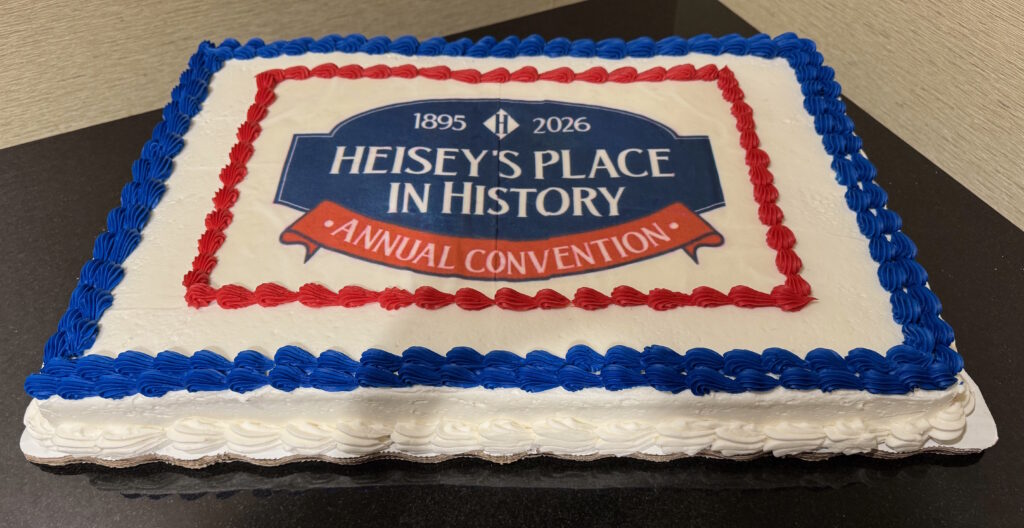
If a time machine had allowed Augustus H. Heisey to visit Newark, Ohio, in 2026 he would probably have been
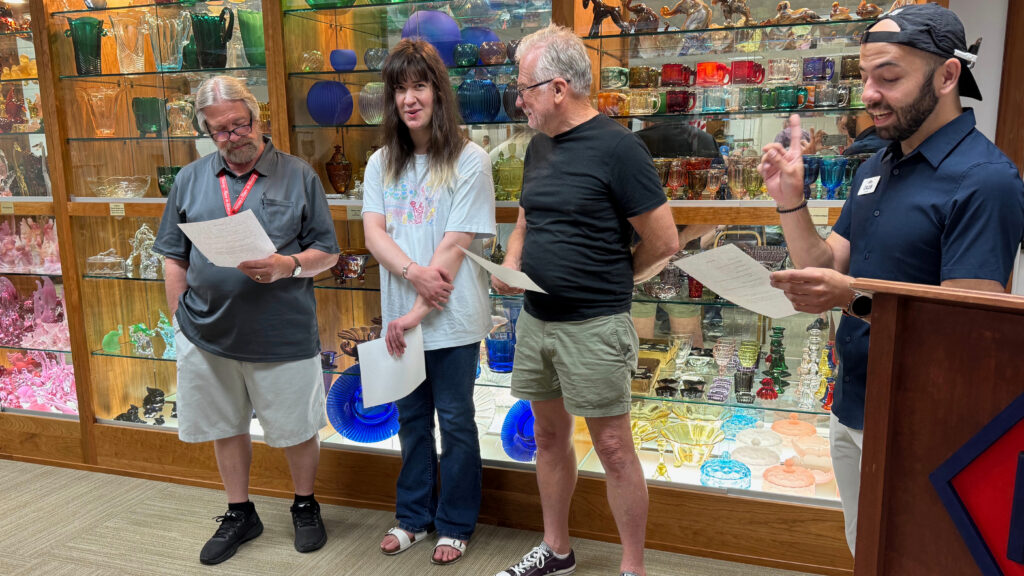
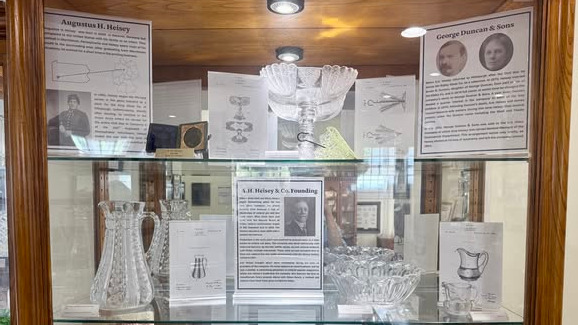
We’re excited to announce a new display on view now in the Walter R. Ludwig gallery! A few months ago
There are 11 HCA-chartered study clubs located throughout the country, plus a virtual study club welcoming HCA members from around the country and the world. Study club membership provides an excellent opportunity to learn more about Heisey glass and to connect with fellow Heisey collectors. To find a study club near you or to learn more about the virtual study club, click on the link below.