
Heisey Etchings and Carvings
During its first years, A. H. Heisey & Company was known for the production of high-quality pressed glassware. With the establishment of its blown ware department in around 1914 or 1915, the company expanded its product lines to include blown wares. The company also established its etching department at around the same time. Not surprisingly, many of the early Heisey etchings are found on blown wares, especially stemware, which was made either with pulled stems or with a blown bowl and pressed stem (a Heisey innovation). Yet a considerable number of these etchings, particularly the earliest ones, are also found on pressed wares such as baskets, trumpet vases, and candlesticks.
Etching is a process for adding a decoration to glassware by exposing selected areas of an item to acid. Exposure to acid gives the desired design a “frosted” appearance, in contrast to the clear or colored glass of the item itself. Heisey produced etchings using three processes: needle etching, pantograph etching, and plate etching.
Needle etchings
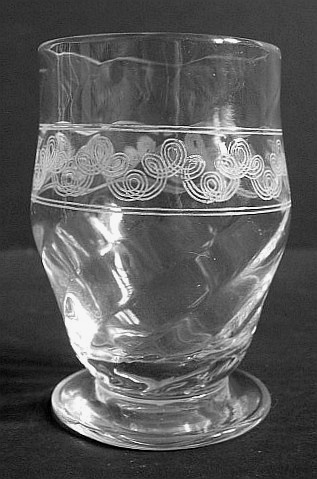
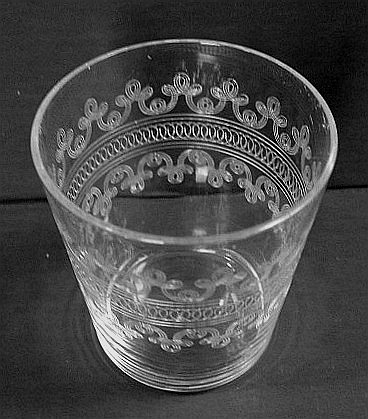
Needle etchings were produced by machines. A coating of acid-resistant beeswax was first applied to the item to be etched. The item was then clamped into position so that a machine-operated needle could trace the desired design by cutting through the beeswax. The item was then immersed in an acid bath to produce the etching.
Needle etchings are most often seen on stemware, such as Nos. 3312 Gayoso, 3308 Bob White, 3333 Old Glory, 3350 Wabash, and 3394 Saxony, among others. Heisey produced needle etchings from about 1914 to 1928.
Because they are produced by machine, the designs of needle etchings consist of simple lines, zig-zags, curves, and loops in a variety of configurations. Many companies produced needle etchings with the same machines used by Heisey. For this reason, it is often difficult to identify a needle-etched piece as Heisey unless it is a distinctive Heisey shape or pattern.
Pantograph etchings
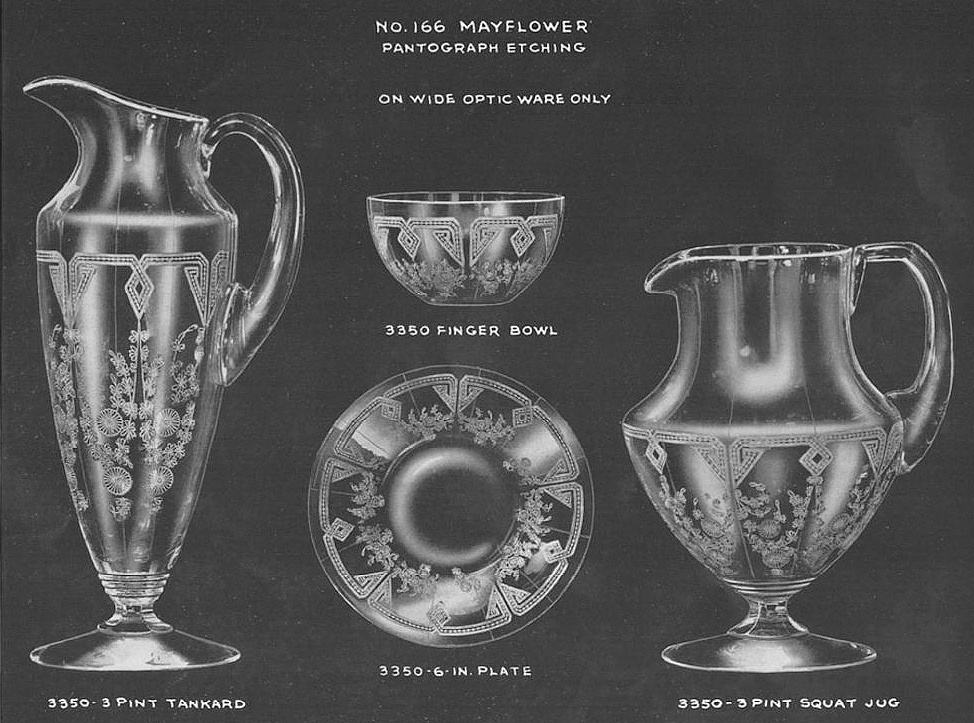
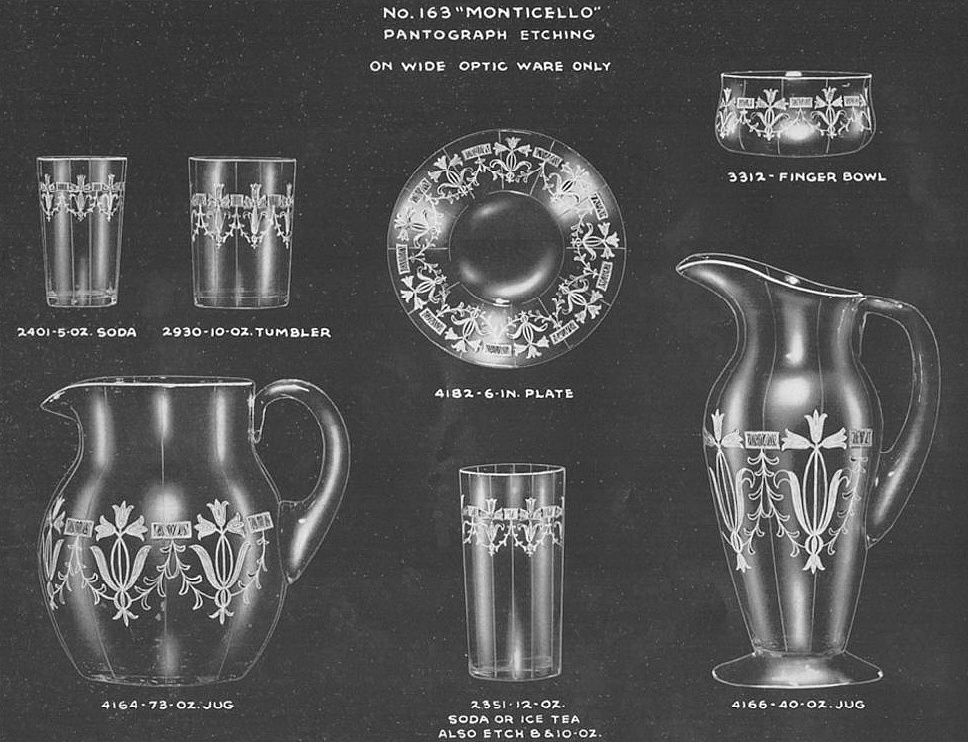
Pantograph etchings have more varied and intricate designs than needle etchings but were also produced by machine. The pantograph machine allowed the etching design to be enlarged or reduced in size to fit a specific item. An oversize version of the design is cut into a large steel plate. The glass worker then traces the design with a stylus. The movement of the stylus is followed by a small needle that scratches the design, in the proper size, onto the wax-coated item that has been placed on a revolving platform. The item is then placed into an acid bath to bring out the design.
Heisey’s pantograph etchings are numbered between 100 and 200 and were produced from around 1919 to 1930, with a few continuing in production until the early 1930s. The pantograph etchings most familiar to today’s collectors include Nos. 160 Osage, 163 Monticello, 166 Mayflower, 168 Adam, and 170 Cleopatra. They are primarily found on stemware lines of the period.
Plate etchings
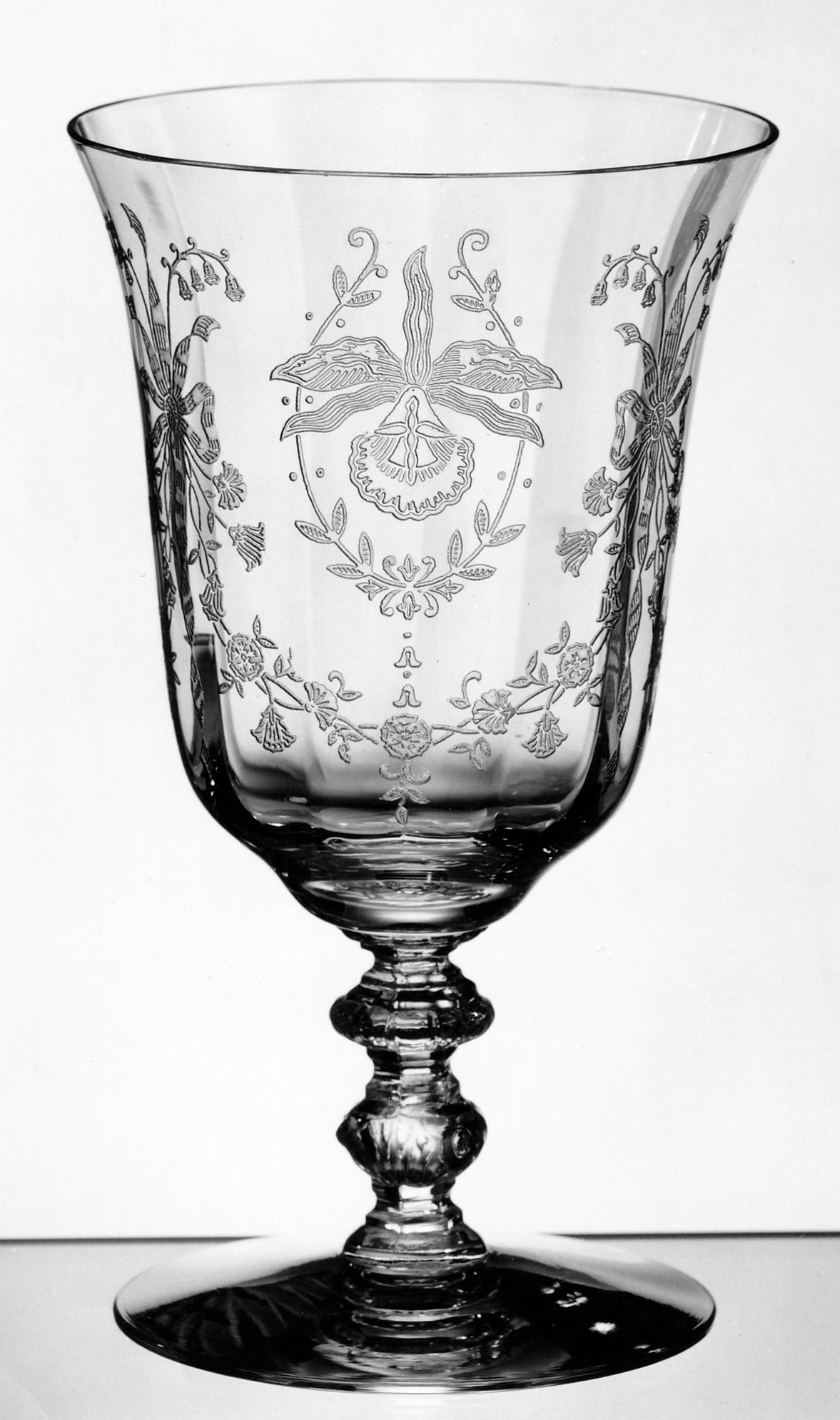
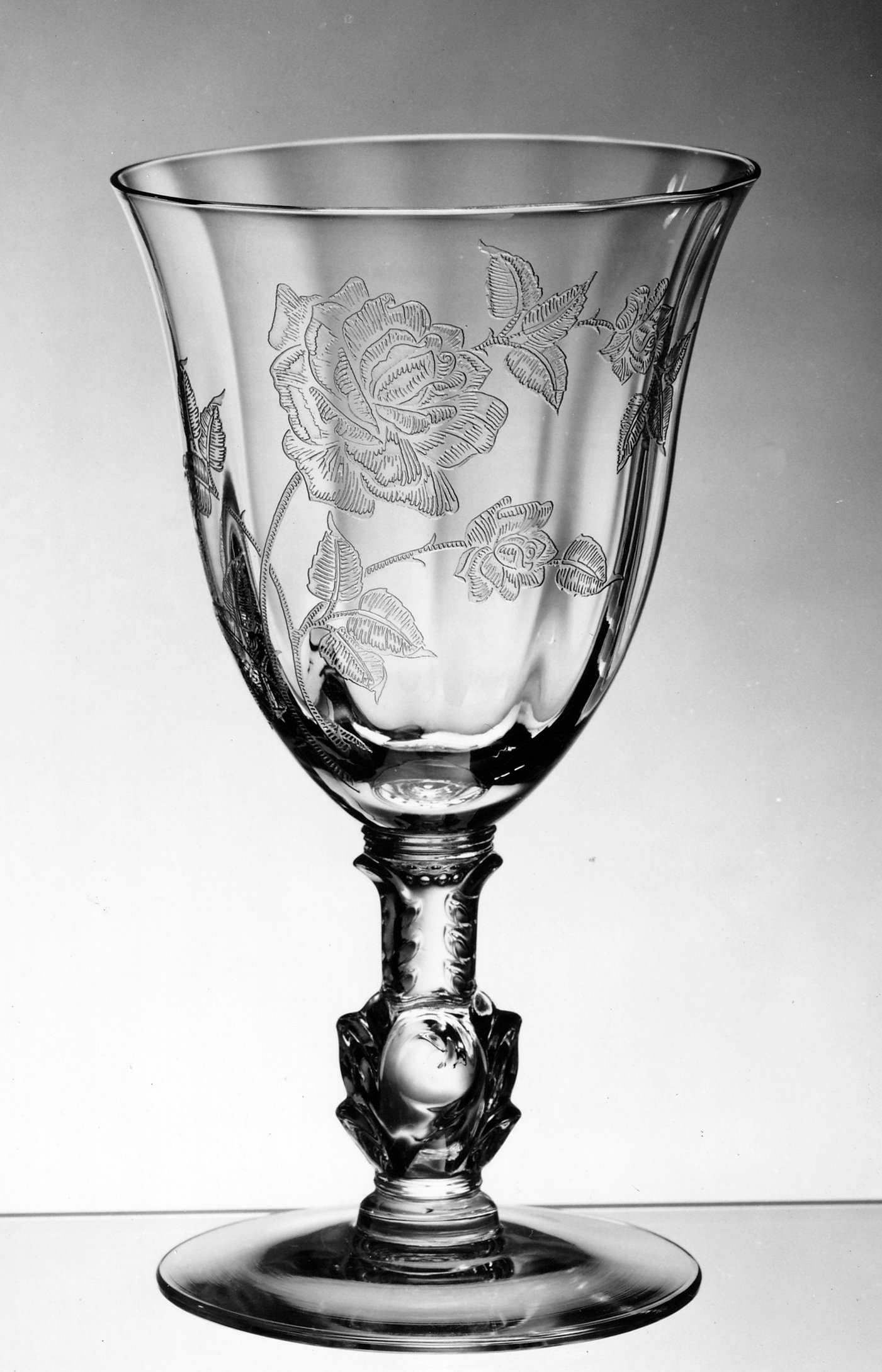
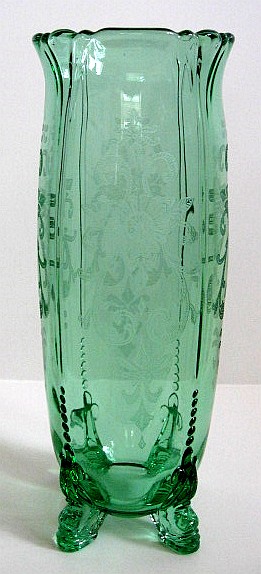
Plate etchings were more elaborate than the earlier needle and pantograph etchings and allowed for greater artistry in their designs. The most popular style of etching done by Heisey was plate etching, and the company produced plate etchings from around 1916 until its closing in 1957. The company’s most famous etchings, Nos. 507 Orchid and 515 Heisey Rose, were plate etchings.
The plate etching process was much more labor-intensive than the processes used to produce needle and pantograph etchings. A designer would first produce drawings in different sizes for each item to which the etching was to be applied. The design would then be transferred photographically to an etching plate, which was itself etched to show the design in relief.
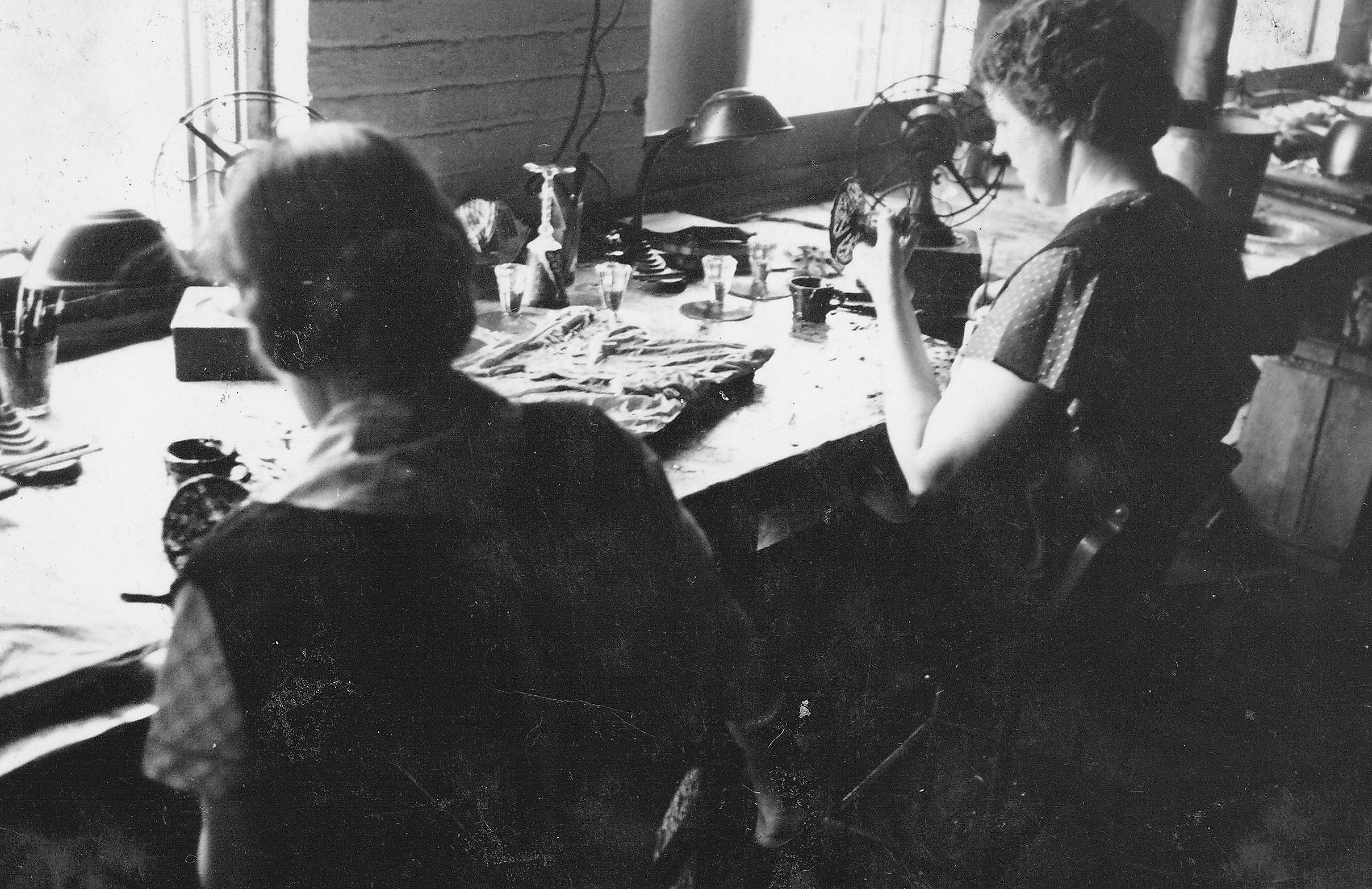
To produce an etching on a single item, the plate would be inked with an acid-resistant mixture of beeswax and carbon. The ink was removed from the raised areas (the etching design), before tissue paper was pressed onto the plate to pick up the acid-resistant ink from the areas around the design. The tissue paper would then be carefully placed on the item to be etched. After the acid-resistant ink hardened, the tissue paper would be removed, leaving behind a “negative” of the design, with all areas of the item except the design covered by the acid-resistant ink. The item would then be placed in an acid bath to produce the etched design.
Heisey produced many attractive and popular plate etchings over a four-decade period. Many of Heisey’s early plate etchings appeared on baskets, but production soon expanded to include blown stemware and pressed tableware of all types. During the 1920s and 1930s, when colored glass was popular, etchings added to the visual appeal of the colorful wares of the period. Some of the more popular plate etchings include: Nos. 366 Peacock, 431 Victory, 440 Frontenac, 447 Empress, 448 Old Colony, 456 Titania, 458 Olympiad, 480 Normandie, 497 Rosalie, 507 Orchid, 515 Heisey Rose, and 516 Plantation Ivy.
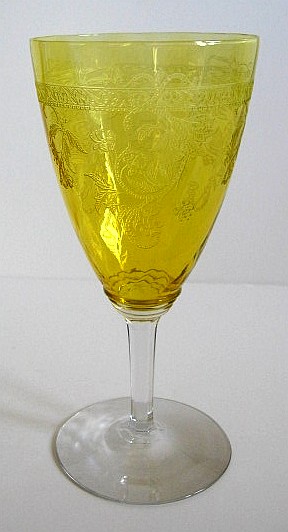
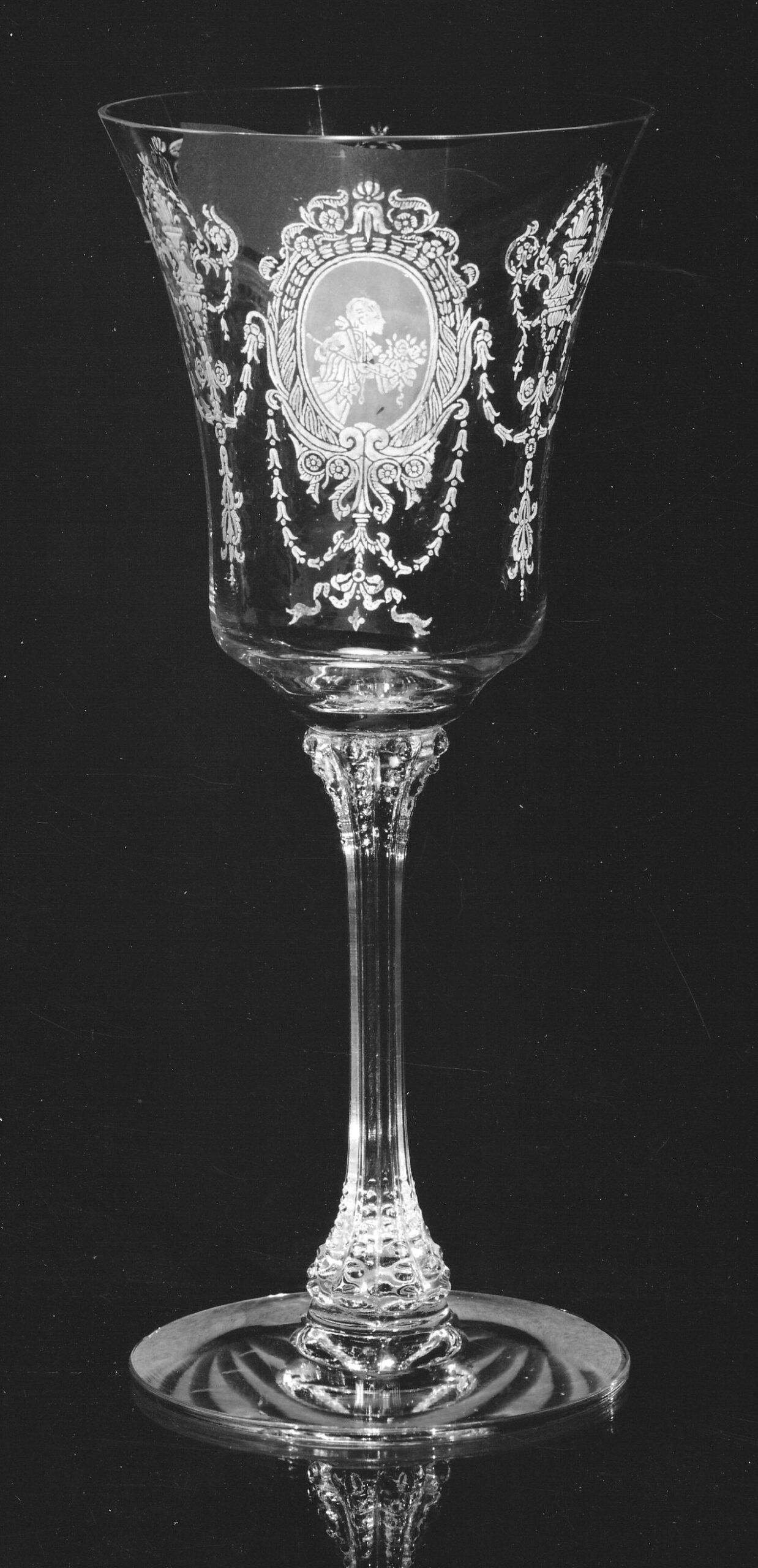
Heisey also produced double plate etchings. As its name indicates, double plate etching involved two etching plates and a two-step process. It was used to produce etchings with a medallion or “cameo,” usually featuring the figure of a person. Heisey’s double plate etchings were also popular and included Nos. 413 Renaissance, 439 Pied Piper, 442 Diana, 445 Trojan, and 503 Minuet.
Silhouette Etchings
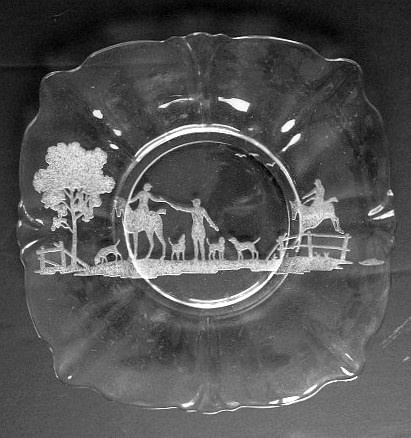
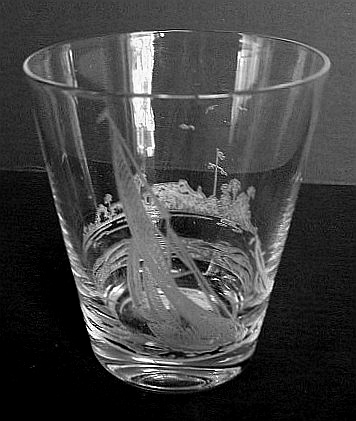
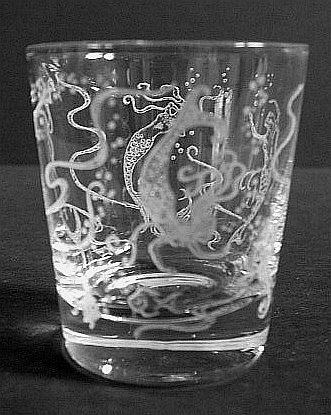
With the repeal of Prohibition in the United States in 1933, American glass companies, including A.H. Heisey & Co., could return to the large-scale production of barware. No longer would a martini pitcher have to be marketed as a “tomato juice pitcher.” Around this time, Ronald Wooles, head of Heisey’s etching department, developed the process of deep plate, or silhouette, etching, which produced distinctive etchings to enhance the barware of the 1930s and 1940s.
Unlike the earlier, more delicate plate etchings consisting primarily of series of thin lines, silhouette etching, as its name indicates, produced an etched-out silhouette of a person, an animal, or an object. The entire area of the design was etched, instead of only its outline. After the article of glass was covered with acid resist outside the pattern area, the article was dipped into a solution of water and hydrofluoric acid for 45 to 60 minutes. This process resulted in etched designs with irregular surfaces that are more heavily frosted in some areas and more transparent in other areas. The etched areas appear to be raised but actually are below the surface of the glass.
A patent for the silhouette etching process was granted in 1936. Because the process was patented, silhouette etching is unique to Heisey products, and items with these etchings are considered highly desirable and collectible today.
The first silhouette etchings were the Nos. 455 Sportsman and 9009 Arctic etchings, introduced in 1932. Introduced in 1933, the No. 467 Tally Ho etching was produced for the longest time, remaining in production until 1952.
Reflecting the Heisey family’s love of horses, several silhouette etchings have equestrian themes, including Nos. 462 Fox Chase, 463 Equestrian, and 481 Lancaster. Other etchings have sports themes, such as Nos. 459 Fisherman, 465 Golf Scene, 466 Athletic Scenes in Border, 495 Polo Player, 496 Skier, and 498 Modern Polo Player. Still others are whimsical, such as the series of Circus etchings (Nos. 471-476) depicting a Rube, a Lion Tamer, a Camel, Clowns, an Elephant, and a Western Scene.
The Nos. 1 Short Sailboat, 2 Tall Sailboat, and 3 Motor Boat etchings appeared, appropriately, on No. 2323 Navy barware as well as on other barware lines. The No. 469 Mermaids etching appeared both on barware and on the No. 4045 ball vases, including the 7″ vase in Alexandrite and Cobalt.
The Nos. 455 Sportsman, 459 Fisherman, 460 Club Drinking Scene, 462 Fox Chase, and 463 Equestrian etchings are found on the No. 4163 Whaley pretzel jar.
Two silhouette etchings feature birds: No. 499 Good Morning, which appears on a juice set consisting of a quart pitcher and juice glasses, and No. 9025 Chicken Chase.
The patriotic No. 9012 Victory silhouette etching was introduced in 1942, making an optimistic statement in the early days of the United States’ participation in World War II.
In 1950, Heisey introduced the Western-themed No. 517 Winchester ’73 silhouette etching, made to match the Vernon Kilns china pattern of the same name. This etching appeared on No. 6060 Country Club barware. Another silhouette etching with a “Wild West” theme is the rare No. 8 Bucking Bronco.
Carvings
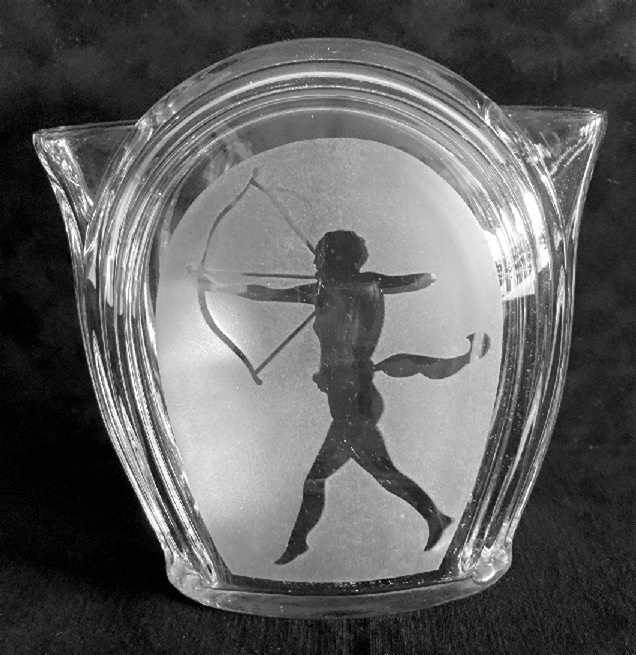
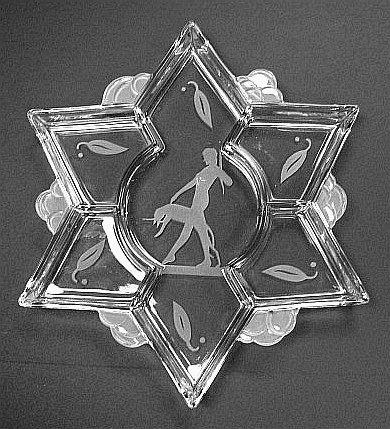
Heisey first produced glassware decorated with carvings in 1934, with some production continuing until 1944. Many of the Heisey carvings had Art Deco style designs and were very popular. Based on its availability today and long production period (1934-1944), the No. 5003 Nimrod carving was Heisey’s most popular decoration of this type.
Carvings look similar to etchings but were produced in an entirely different way: by sandblasting instead of acid etching. The process began with coating the glass with a rubbery material. This coating is resistant to the sandblast and protects the glass from abrasion. With the use of a stencil, the area to be carved was cut into the coating and peeled away, exposing the glass surface to be carved. The carving operation was done in a sandblast chamber, using high air pressure. The impact of the sand carves the exposed surface, giving the glass the appearance of having been etched. When the carving operation was complete, the coating was removed, revealing the clear, unaffected area. A wide variety of complex patterns can be produced by controlling the depth of the carving.
Heisey produced a total of twenty-four known carvings, which are listed below. They are often found on barware such as soda or highball glasses, shot glasses, bitters bottles, and bar bottles and decanters. They are also found on serving pieces such as the No. 500 Octagon variety tray and the No. 1466 Star relish, and several vases. Multiple items in the No. 4044 New Era line were offered with the No. 5010 Vanity Fair carving.
Carvings were not exclusive to Heisey. Other companies, including Fostoria, Duncan Miller, and Tiffin, produced carvings. Some decorating artists also worked with sand carvings. Two notable glass artists who used Heisey blanks for carvings were Dorothy Thorpe and Frank Oda. The technique of sand carving glass is still used by glass artists today.
Heisey Carvings
- No. 5000 Bacchus, 1934-1939
- No. 5002 Sweet Adeline, 1934-1937
- No. 5003 Nimrod, 1934-1944
- No. 5004 Scotch, 1934-1937
- No. 5005 Bourbon, 1934-1937
- No. 5006 Gin, 1934-1937
- No. 5007 Rye, 1934-1937
- No. 5008 Castle Harbor, 1934-1937
- No. 5009 Diana, 1934-1937
- No. 5010 Vanity Fair, 1935-1938
- No. 5011 Chevy Chase, 1935-1938
- No. 5012 Amfalula Tree, 1935-1937
- No. 5013 Nymph & Satyr, 1935-1938
- No. 5014 Swan Dive, 1935-1938
- No. 5015 Stripes, 1935-1938
- No. 5016 Stars & Stripes, 1935-1938
- No. 5017 Sailboat, 1937-1942
- No. 5020 Lily, 1939-1941
- No. 9045 Angel Fish, production dates unknown
- No. 9086 Graphic Weave, production dates unknown
- No. 9125 Arabian, production dates unknown
- No. 9228 Knight on Steed, production dates unknown
- No. 9234 Skater, production dates unknown
- Sandblasting overall (no Heisey number), production dates unknown