
The Colors of Heisey
Crystal
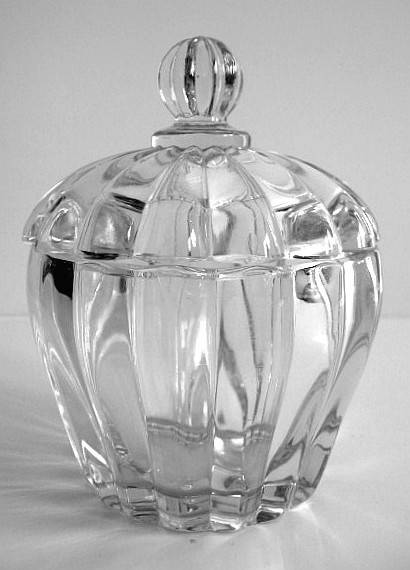
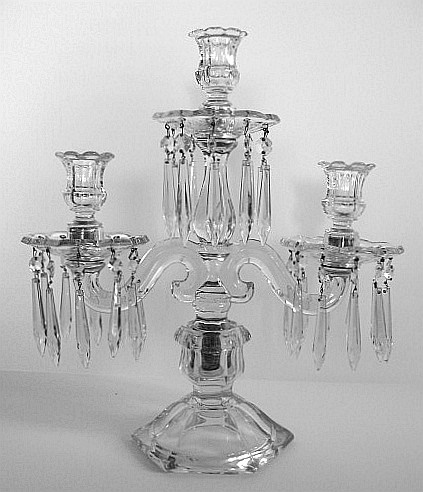
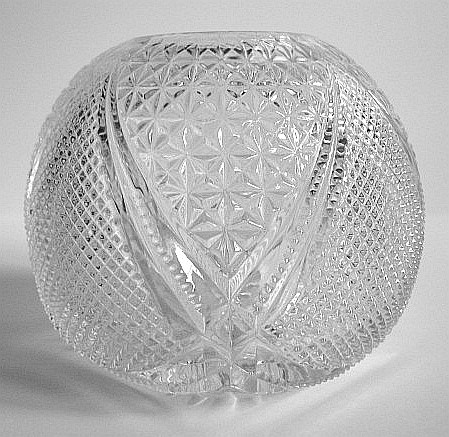
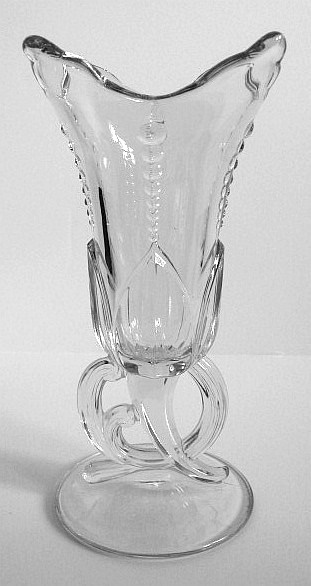
Crystal (1896-1957) was Heisey’s name for its clear colorless glass. Heisey’s Crystal is known for its clarity and sparkle. A.H. Heisey is said to have preferred Crystal to colored glass, which explains the high quality of Heisey’s Crystal. Almost everything made by Heisey was made in Crystal, even if a particular item or pattern was also made in one or more colors. A few items were not listed in Crystal in Heisey’s catalogs and price lists, mostly in the 1920s and ’30s, when colored glassware was popular.
The element manganese was used as a clarifying agent in the formula for Heisey’s Crystal. The presence of manganese causes Crystal glass to emit a yellow glow under a 365nm black light. It also causes the glass to take on a lavender tint with prolonged exposure to sunlight.
The simple designs of Heisey’s Colonial style patterns showcase the quality of Heisey’s Crystal, and most of these patterns were made only in Crystal. Other major patterns made primarily or exclusively in Crystal include Nos. 150 Banded Flute, 433 Greek Key, 1469 Ridgeleigh, 1503 Crystolite, 1519 Waverly, 1540 Lariat, and 1567 Plantation. From the 1920s on, Crystal was used in combination with colors, primarily in stemware lines such as Nos. 3380 Old Dominion, 3381 Creole, 3390 Carcassonne, 3397 Gascony, and 3404 Spanish, among others.
Emerald
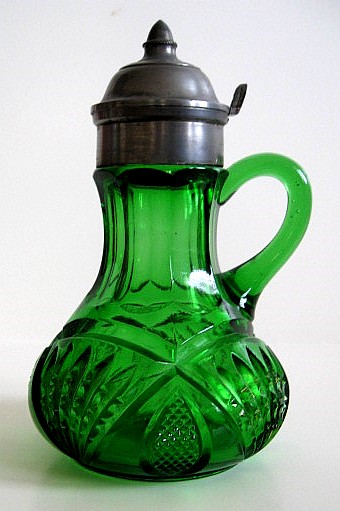
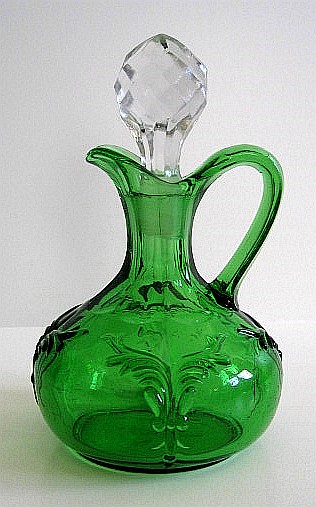
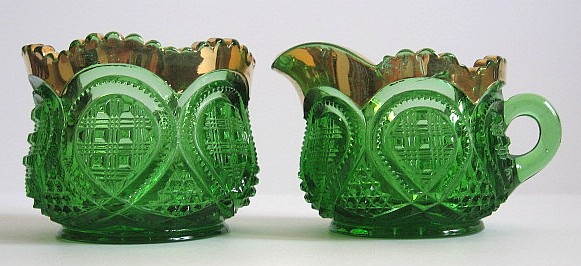
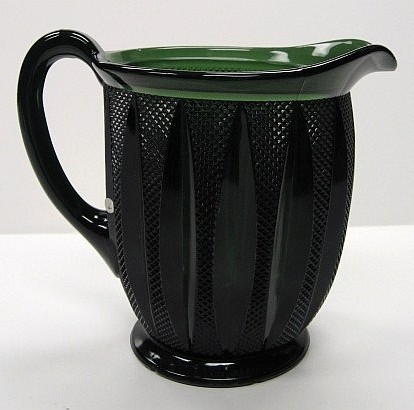
Emerald (1896-early 1900s) was Heisey’s first production color. It is a deep sparkling green, similar to the dark green glass produced by other glassmakers of the period. Items in Emerald are often found with gold decoration on elements of their design, especially on the intricate pressed patterns mimicking the cut glass of the time. Items in Emerald are most often found in the Nos. 1280 Winged Scroll, 1255 Pineapple and Fan, and 1205 Fancy Loop patterns. Emerald examples are less frequently found in other early patterns, including Nos. 1295 Bead Swag, 160 Locket on Chain, 150 Pointed Oval in Diamond Point, and others. A few items in Nos. 150 Pointed Oval in Diamond Point and 1255 Pineapple and Fan are known in “Black Emerald,” a very dark shade of green that appears almost black.
Ivorina Verde
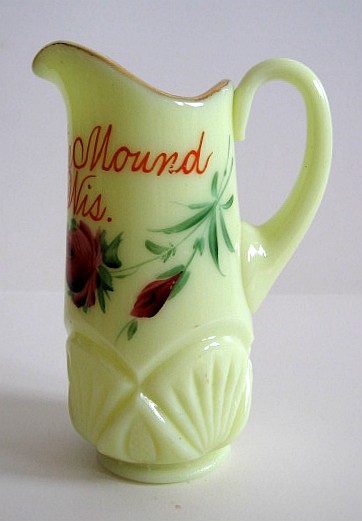
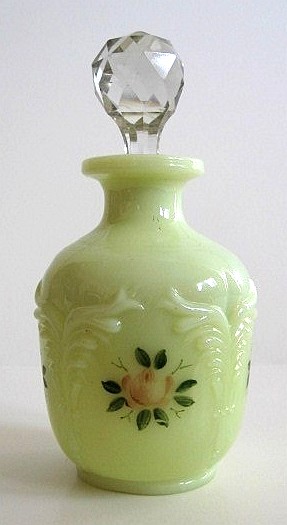
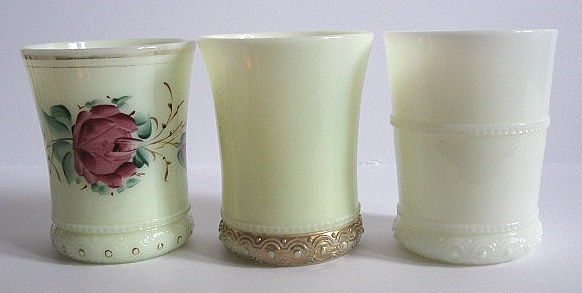
Ivorina Verde (1897-early 1900s) was Heisey’s name for its opaque custard glass. Its color ranged from light yellow to a darker shade of yellow that is more closely associated with custard glass. Much of Heisey’s production in Ivorina Verde was in two major pattern lines, Nos. 1280 Winged Scroll and 310 Ring Band. More than fifty items were offered in the color in the Winged Scroll line. The No. 310 Ring Band pattern, introduced in 1900, was produced primarily in Ivorina Verde. A few items were made in Ivorina Verde in other early patterns, including Nos. 1205 Fancy Loop, 1295 Bead Swag, 1235 Beaded Panel and Sunburst, 1200 Cut Block, 1220 Punty Band, and 1225 Plain Band. A variety of decorations can be found on items in Ivorina Verde, including gold or green on pattern elements and hand-painted floral decorations. Items in Ivorina Verde are often found with souvenir decorations and inscriptions.
Opal
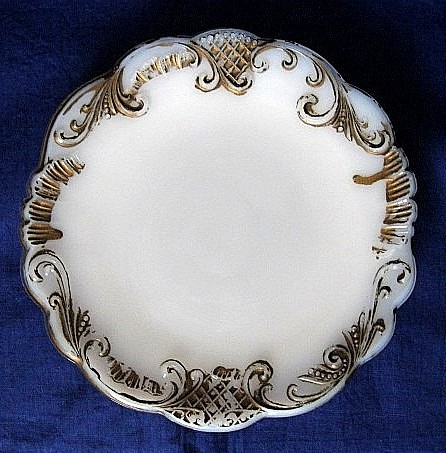
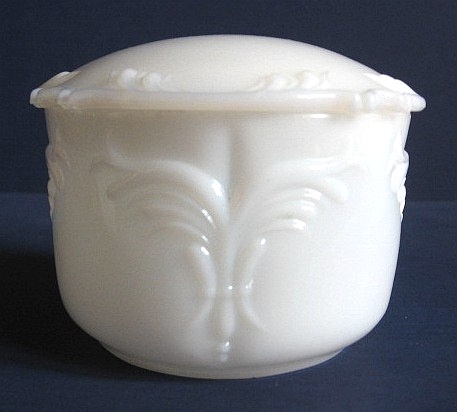
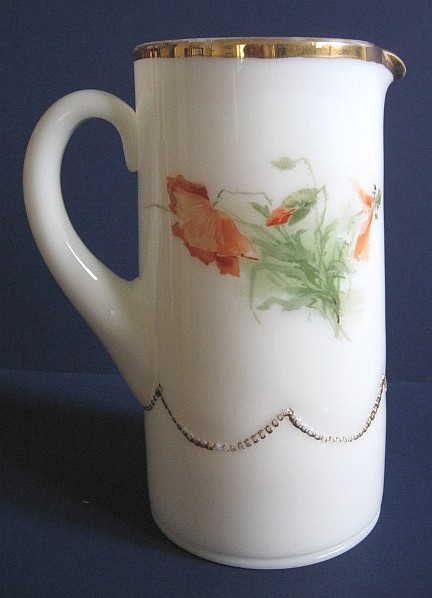
Opal (1898-early 1900s) was Heisey’s name for the opaque white glass that is called “milk glass” today. Items in Heisey’s Opal are sometimes translucent and show a blue opalescence at their rims and edges. The pattern most often found in Opal is No. 1295 Bead Swag, with examples less commonly found in No. 1280 Winged Scroll. Scarce items in Opal include the No. 160 Locket on Chain table set; No. 1235 Beaded Panel and Sunburst punch bowl and base; No. 1255 Pineapple & Fan ½ pint tankard; No. 1220 Punty Band mug; and No. 310 Ring Band tumbler. Heisey’s Opal glassware was decorated with gold, hand-painted florals, and souvenir decorations and inscriptions.
In about 1902, Heisey also produced a line of Opal novelty items similar to those being made by other companies of the period. Known items made by Heisey are marked with both a number and the Diamond H. The line includes an ash receiver, a match holder, plates, and vanity items such as a puff box and a comb and brush tray.
Canary
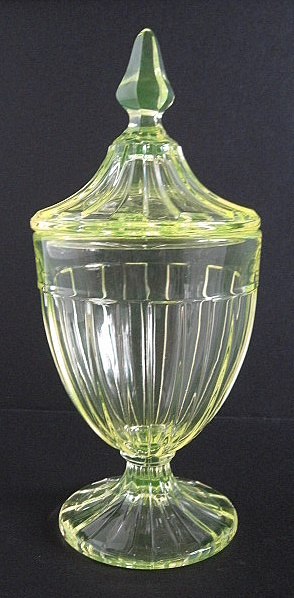
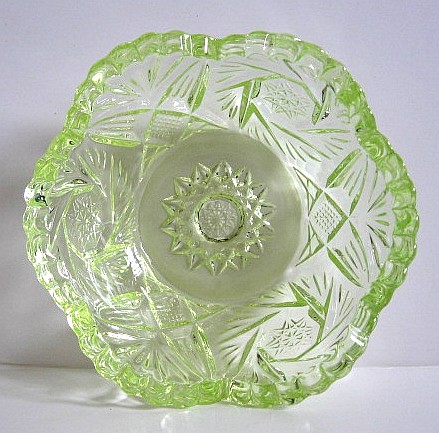
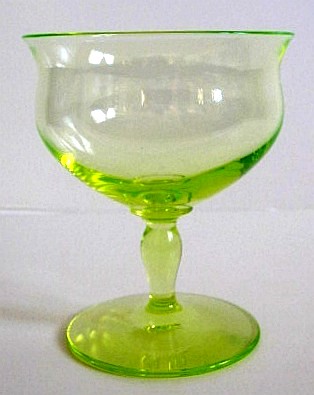
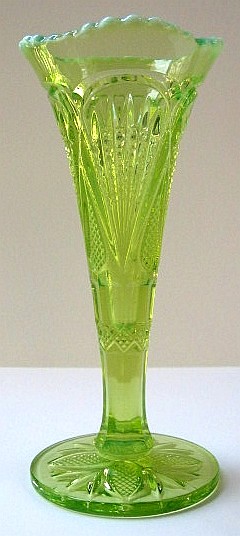
Canary (1897-1899, 1919, c.1923-1924) is a greenish-yellow color, called “Canary” by Heisey and “Vaseline” by collectors. Glass in Canary glows a bright yellow under a black light. No full patterns were made in Canary. Examples of Heisey’s early production in Canary can be found in the following patterns: Nos. 160 Locket on Chain, 1280 Winged Scroll, 1255 Pineapple and Fan, and 350 Pinwheel and Fan. Pieces from this era are a bright yellow in color. Later production in the color included pieces in Nos. 1184 Yeoman, 473 Narrow Flute with Rim, 465 Recessed Panel, 451 Cross-lined Flute, 1193 Inside Scallop, plus the No. 1020 Phyllis cream and sugar, No. 1201 Laverne floral bowl, and No. 3345 Mary ’n Virg stemware. A few Colonial style pieces in Nos. 341½ Puritan, 353 Medium Flat Panel, and 351 Priscilla are also known. Items found in this later Canary are paler and subtler in color than the early production.
Amber
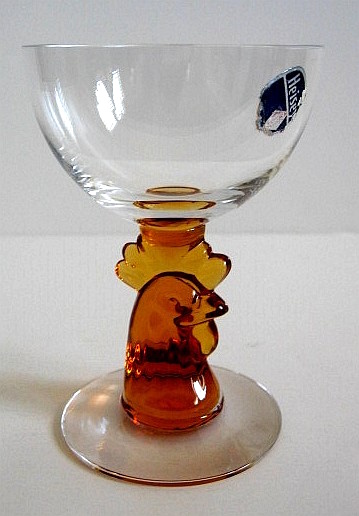
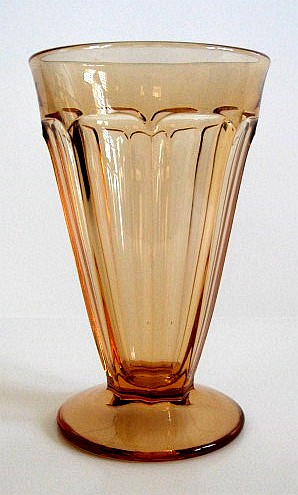
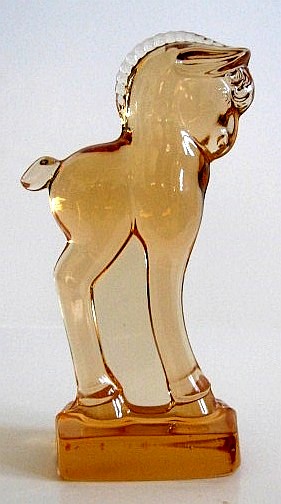
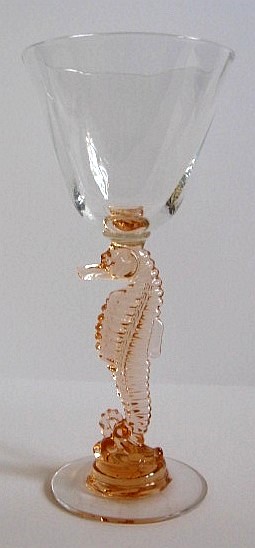
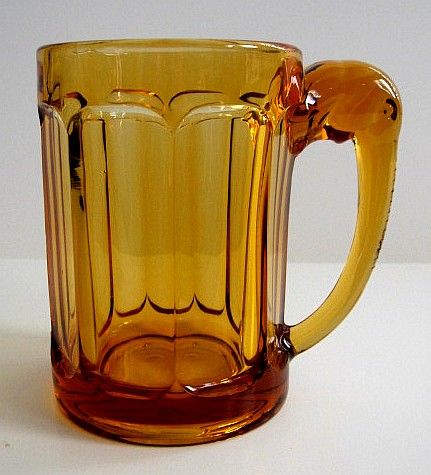
Amber (c.1920s-1950s) is a transparent brown color that was made in several different shades by Heisey. The company first produced Amber glassware for the Fred Harvey restaurants in train stations in the Midwest and West, and for railroad dining cars operated by Harvey. Most of this glassware, called “Fred Harvey Amber” by collectors, is in a medium to light shade of Amber. Twenty-five items in various patterns were made in Amber for Harvey.
In 1951, Heisey introduced a deep, rich shade of Amber that it called “Sultana.” Items in Sultana are found in the following patterns: Nos. 1951/6092 Cabochon, 1624 Patio, 5077 Legionnaire stemware, and 5057 Suez stemware. Some figural stemware, including the Nos. 5048 Rooster Head, 5058 Goose Stem, and 5074 Sea Horse cocktails, were offered with Sultana stems. The Sea Horse cocktail is also known with a light Amber stem. Several of Heisey’s animal figurines were made in Sultana, including the Flying Mare, Elephants, Horse Head bookend and Rooster. The Ponies and Oscar (the plug horse) were made in a light shade of Amber, called “Honey Amber” by collectors.
A few Amber pieces were not part of the late production and were not produced for Fred Harvey; they include the No. 110 Sandwich Dolphin candlesticks, No. 1404 Old Sandwich beer mug, No. 1417 Arch tumbler, and No. 1170 Pleat and Panel cruet.
Moongleam
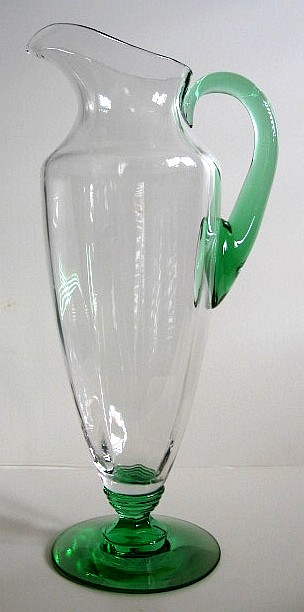
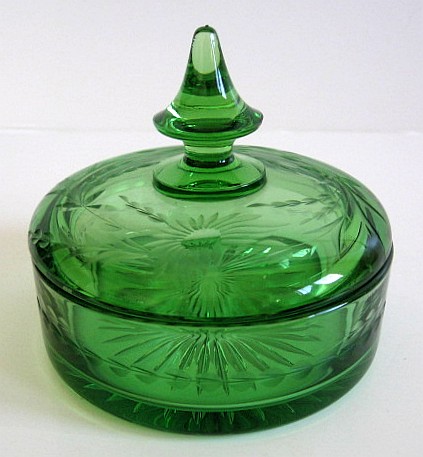
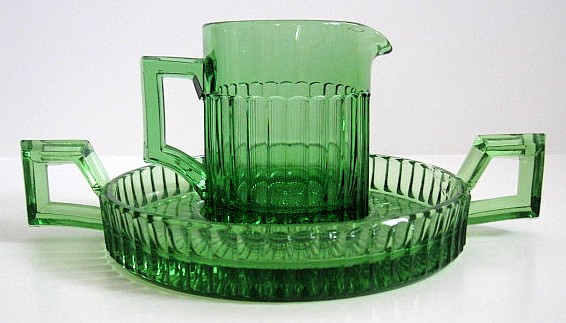
Moongleam (1925-1935) was the first production color of the “color period” of the 1920s and 1930s, when colored glass was in fashion. It is a transparent green, lighter than the earlier Emerald. Heisey’s advertisements described it as “the green of moonlight on the sea.” Moongleam is found in two distinct shades, a more yellowish green and a green that is more nearly a true green. In some cases, the same item was made in both shades, and it can be challenging to assemble sets in Moongleam with a consistent color.
Most major pressed patterns made between 1925 and 1935, or selected items in those patterns, were made in Moongleam; these include Nos. 411-414 Tudor, 1184 Yeoman, 1170 Pleat and Panel, 500 Octagon, 1229 Octagon, 1231 Ribbed Octagon, 1252 Twist, 1401 Empress, 1404 Old Sandwich, and 1405 Ipswich. Stemware of the period was made in all Moongleam or in a combination of Moongleam and Crystal, for example, Crystal bowl and Moongleam stem and foot. The stemware patterns most often found in Moongleam or Moongleam in combination with Crystal include: Nos. 1184 Yeoman, 1170 Pleat and Panel, 1252 Twist, 3355 Fairacre, 3357 King Arthur, and 3380 Old Dominion. Many accessory pieces, such as candlesticks, floral bowls, vases, ash trays, colognes, and several baskets, were also made in Moongleam.
Flamingo
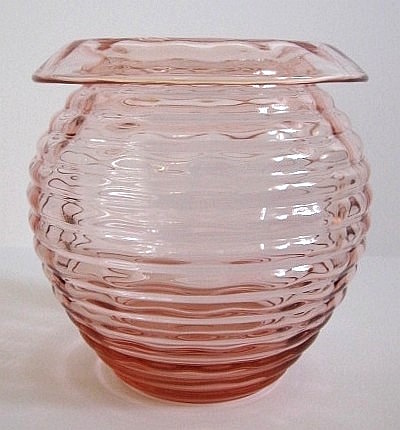
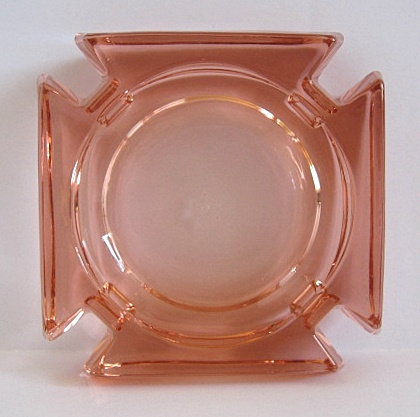
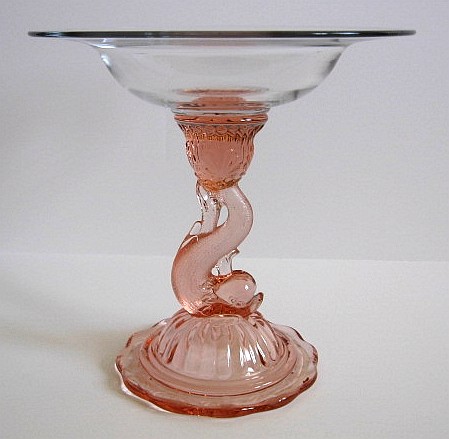
Flamingo (1925-1935) is a transparent pink with a slight orange tint. Evoking the color’s name, Heisey’s advertising of the time described it as “the rose tint of tropical plumage.” The pink color is not always consistent, ranging from a true pastel pink to a more orange shade. This color variation can make it difficult to assemble sets in a consistent shade of Flamingo.
Most of the pressed tableware patterns of the period were offered in Flamingo. They include Nos. 411-414 Tudor, 1184 Yeoman, 1170 Pleat and Panel, 500 Octagon, 1229 Octagon, 1231 Ribbed Octagon, 1252 Twist, 1401 Empress, 1404 Old Sandwich, and 1405 Ipswich. The stemware lines most often found in Flamingo are 1184 Yeoman, 1170 Pleat and Panel, 1252 Twist, 3355 Fairacre, 3357 King Arthur, 3366 Trojan, 3368 Albemarle, 3380 Old Dominion, and 3390 Carcassonne. These stemware lines were usually made in all Flamingo, with a few being offered in a combination of Flamingo and Crystal. Many accessory pieces, such as candlesticks, floral bowls, vases, ash trays, colognes, and several baskets, were also made in Flamingo.
Hawthorne
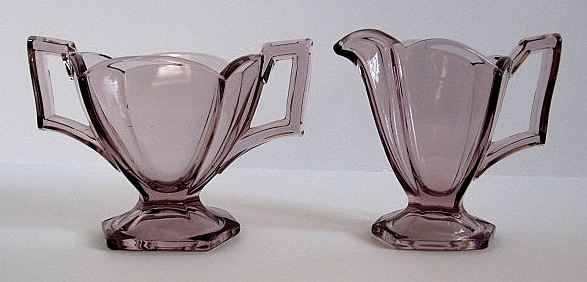
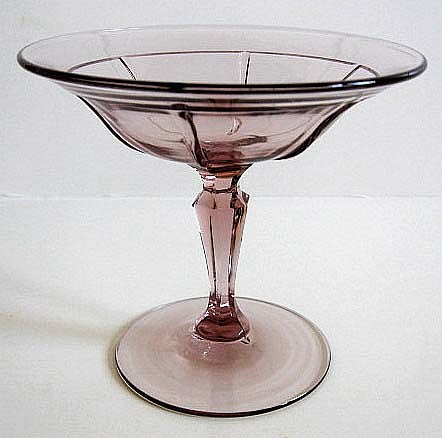
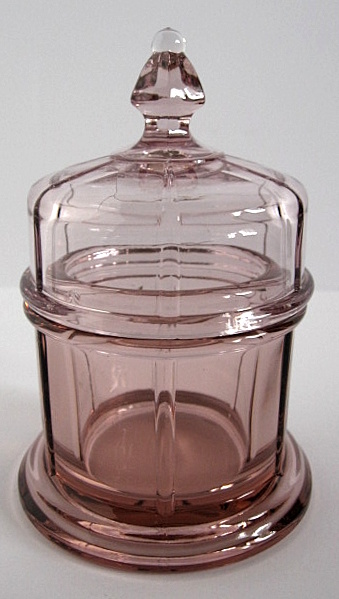
Hawthorne (1927-1928) was Heisey’s first attempt to produce a lavender color. Heisey advertised it as having “the delicate tint of the amethyst,” but that was not always the case. Some pieces, especially blown stemware items, have an attractive lavender color, but other items, especially thicker pressed wares, have a muddy, brownish hue. The color did not sell well, and efforts to improve it were unsuccessful. It was discontinued in the summer of 1928.
Heisey did not offer any complete pressed tableware patterns in Hawthorne, but most items in No. 1229 Octagon were offered in the color. Selected items were made in Hawthorne in the following patterns: Nos. 406-407 Coarse Rib, 411 Tudor, 1184 Yeoman, 1170 Pleat and Panel and 1231 Ribbed Octagon. Stemware in Hawthorne is most often found in the No. 3360 Penn Charter pattern with a “checker” optic; other stemware lines made in Hawthorne include Nos. 3324 Delaware, 3333 Old Glory, 3350 Wabash, and 3366 Trojan. Candlesticks, vases, floral bowls, cream and sugar sets and other accessory pieces were also available in Hawthorne.
Sun-colored items are often offered for sale as Hawthorne, but with a little study, Hawthorne can easily be distinguished from sun-colored glass. The color of Hawthorne has more pink than the lavender of sun-colored glass. In addition, sun-colored items offered for sale as Hawthorne often are from patterns never made in Hawthorne, or from time periods when Hawthorne was not made. Because sun-colored glass is Crystal, it will react like Crystal and emit a pale yellow glow in black light.
Marigold
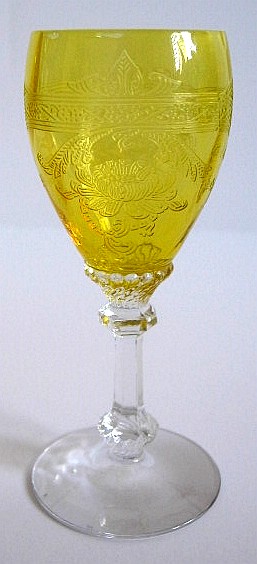
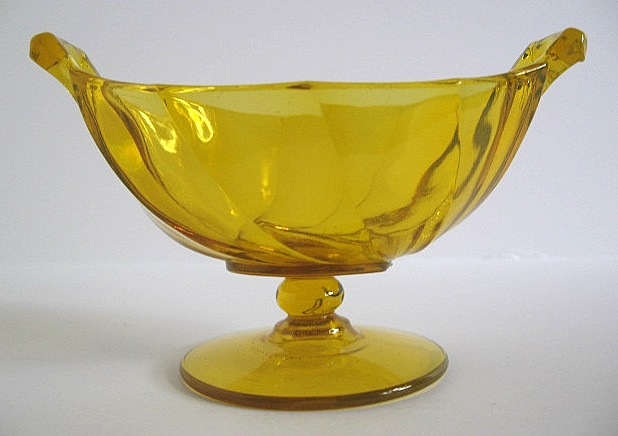
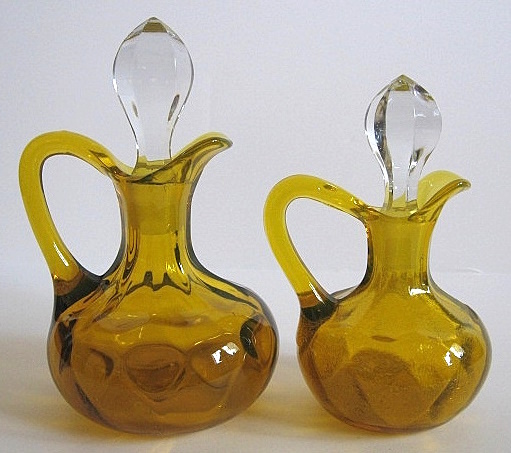
Marigold (1929-1930) is a brassy, deep yellow color with a green tint at the edges, described in Heisey’s advertisements as “sparkling with golden sheen.” It was highly popular but plagued with problems. It was difficult to produce, with Heisey’s workers complaining that the hot glass spat small bits at them when they were attempting to work with it. Some finished items were unstable, showing crazing or flaking or even spontaneously shattering. Still other items developed a coarse granular surface called “sugaring.” After many attempts to solve these problems failed, Marigold was discontinued in 1930.
The complete No. 1252 Twist line was made in Marigold, as was No. 1229 Octagon. Selected pieces in No. 1184 Yeoman were also offered in the color. Several stemware lines were made with Marigold bowl and Crystal stem and foot: Nos. 3380 Old Dominion, 3368 Albemarle, 3362 Charter Oak, and 3350 Wabash. The Marigold bowls of these stemware lines, with a diamond optic and embellished with a Heisey etching, are quite attractive.
Some Heisey glass, most often from the No. 406-407 Coarse Rib pattern, is found with a Marigold stain on Crystal glass. Stained pieces lack the green edge tint of true Marigold and will react like Crystal glass under a black light.
Gold
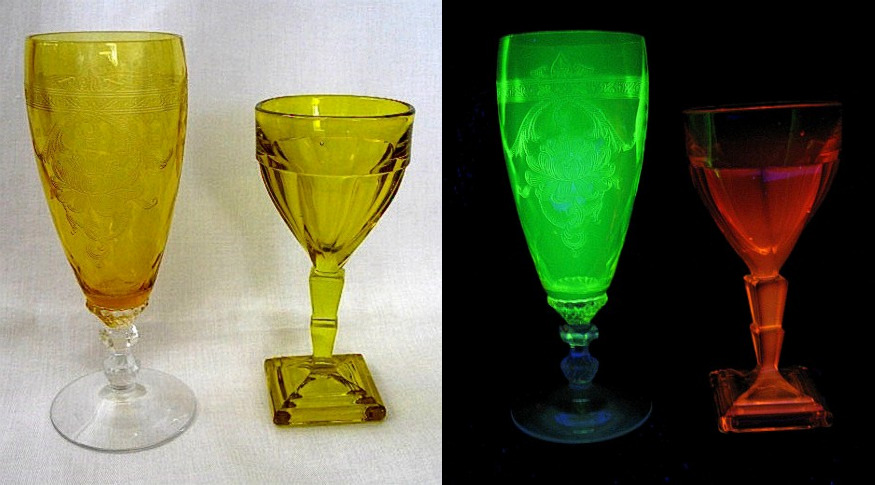
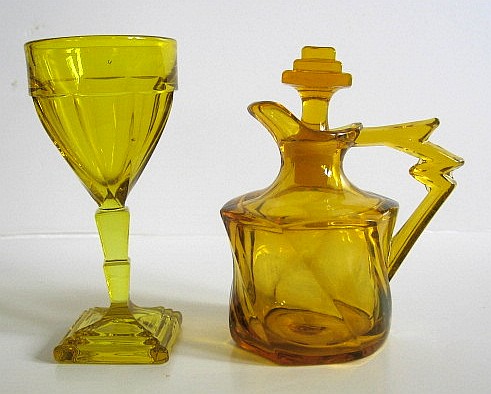
Gold (c. 1929) is a bright, brassy yellow color closely related to Marigold. It may have been developed during Heisey’s attempts to improve the Marigold color or as a possible successor to Marigold. It is difficult to tell the difference between Gold and Marigold unless the two colors are viewed side by side. Gold can also be distinguished from Marigold with the use of a black light. Under a black light, Marigold glows a brilliant yellow-green, while the glow of Gold is a salmon pink. Most items in Gold are found in the No. 1252 Twist pattern.
Sahara
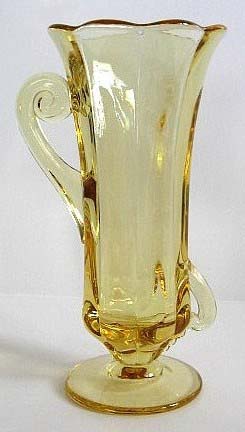
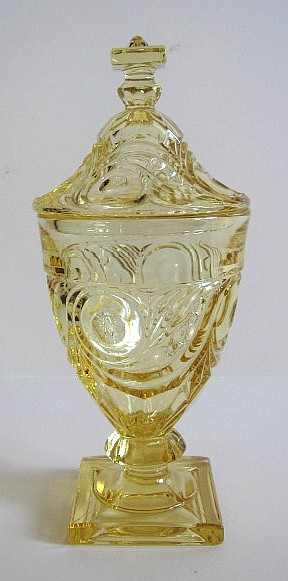
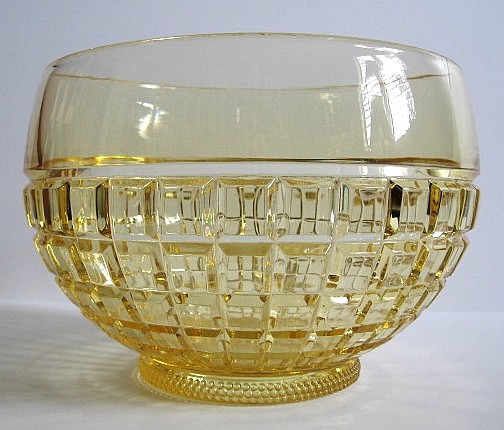
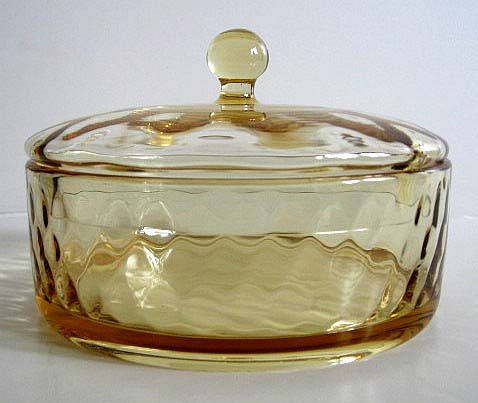
Sahara (1930-1937) is a clear, golden yellow. Heisey’s advertisements described it as “the yellow of sunny sands,” “a bright hue of yellow desert sand,” and “bright with the golden tone of sunshine.” A successful replacement for Marigold, it was popular with the buying public and was one of Heisey’s best-selling colors, second only to Flamingo. In the early years of its production, lead was used in the formula, adding brilliance to the color and allowing Heisey to claim it was the first transparent yellow glass to be produced in lead glass.
The major patterns of the 1930s were available in Sahara, including Nos. 1401 Empress, 1404 Old Sandwich, 1405 Ipswich, 1425 Victorian, 1428 Warwick (Horn of Plenty), and 1447 Rococo. Some items in Nos. 1252 Twist and 1184 Yeoman were also made in Sahara. Stemware lines offered in Sahara included Nos. 3380 Old Dominion, 3389 Duquesne, and 3390 Carcassonne. Stems in the Nos. 3381 Creole and 3404 Spanish lines with a Sahara bowl and Crystal stem and foot are desirable and not easy to find today.
With the end of Prohibition in 1933, Heisey expanded its production of barware and related items, many of which were offered in Sahara. Accessory pieces such as vases, floral bowls, candlesticks, cream and sugar sets, and smoking accessories were also offered in Sahara.
Alexandrite
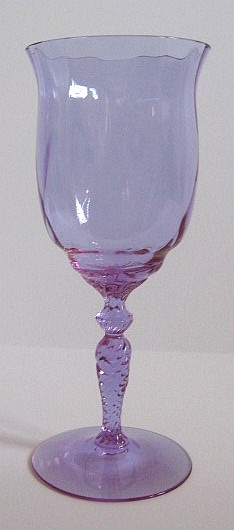
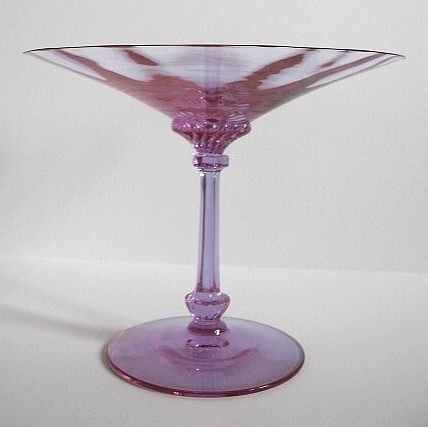
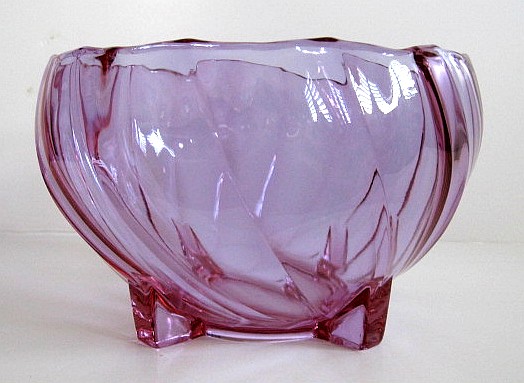
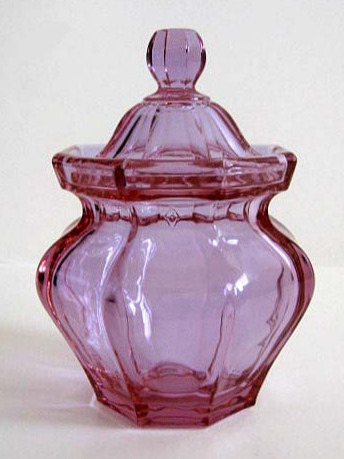
Alexandrite (1930-1935) is a clear lavender color that replaced the unsuccessful Hawthorne color. It was advertised as having “the delicate glow of treasured amethyst.” When viewed from different angles, the color may vary, sometimes appearing more pink in tone, and sometimes appearing more blue. It was Heisey’s most expensive color to produce and was promoted for the luxury trade.
Heisey’s Alexandrite glass is “dichroic” or “dichromatic,” meaning that its color appears different under different lighting conditions. The most striking color change occurs when Alexandrite glass is placed under fluorescent light, where it has a rather unattractive greenish-blue tint. The color change is caused by a rare earth element, neodymium, in the formula. It is an easy way to tell the difference between Alexandrite and Hawthorne or Crystal glass that has acquired a lavender tint from exposure to sunlight.
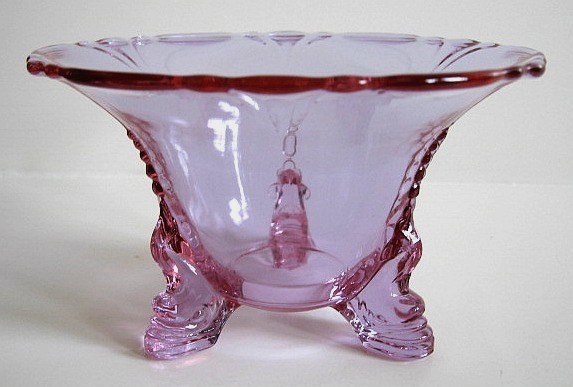
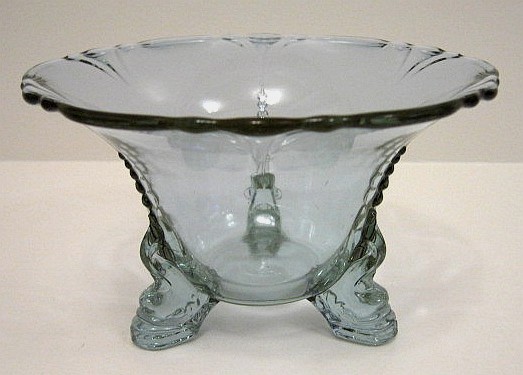
The color is most often found in the No. 1401 Empress line and the No. 3380 Old Dominion, 3381 Creole and 3390 Carcassonne stemware lines. About 30% of the pieces in the Empress line were offered in Alexandrite. Old Dominion stemware was made in all Alexandrite. The Creole line was offered in all Alexandrite and with an Alexandrite bowl and Crystal stem and foot. Carcassonne stemware was made with an Alexandrite bowl and Crystal stem and foot. Some accessory pieces, such as vases, floral bowls, and candlesticks, were also made in Alexandrite, including the No. 134 Trident two-light candlesticks and floral bowl, 4045 ball vase, and the 4220 Janice, 4216 Octagon, and 1413 Cathedral vases. A few rare Colonial items are also found in Alexandrite; the No. 1000 Maezene marmalade in Alexandrite is a favorite of collectors.
Tangerine
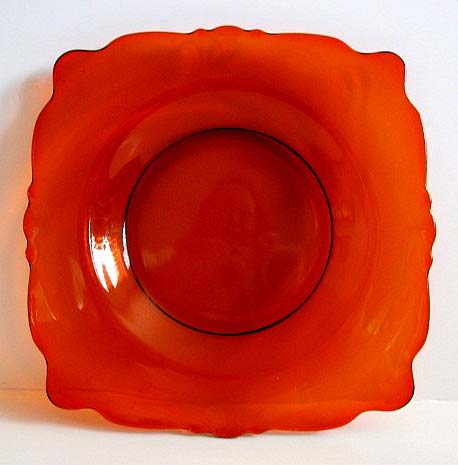
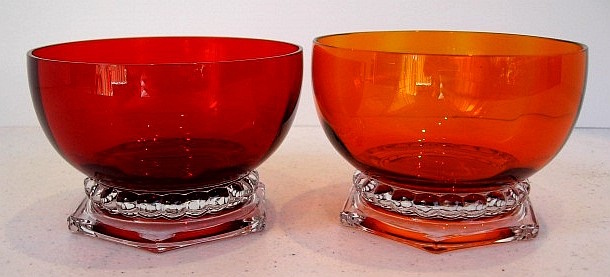
Tangerine (1932-1935) is a deep orange-red. It is a “struck” color, meaning that the color does not appear until the glass is re-heated in the glass furnace. This re-heating process resulted in a color that varies from a light orange to almost a true red. The difficulty of producing a consistent color resulted in limited production in Tangerine and accounts for the color’s scarcity today.
Most Tangerine items are found in three stemware lines, Nos. 3389 Duquesne, 3397 Gascony, and 3404 Spanish. Most pressed wares in Tangerine are found in the No. 1401 Empress line, but only selected items in the pattern were made in Tangerine. The No. 1413 Cathedral vase is known in Tangerine. All six shapes of Heisey’s favor vases were also made in Tangerine.
Stiegel Blue
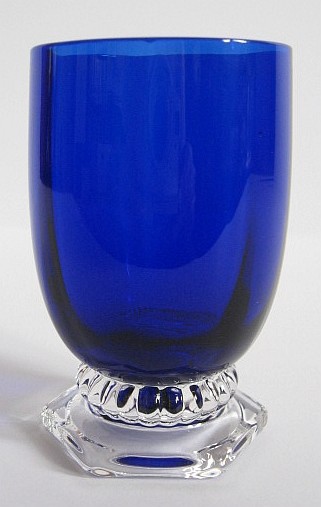
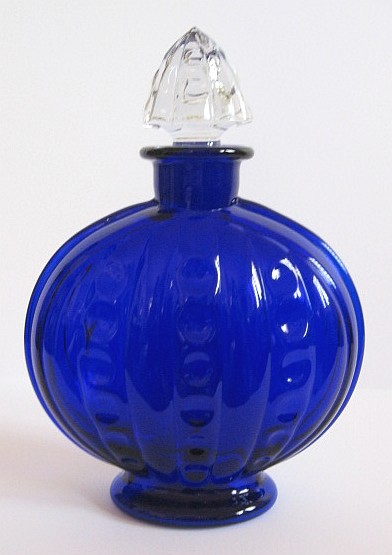
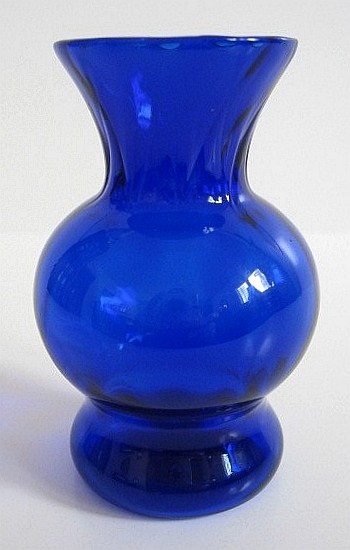
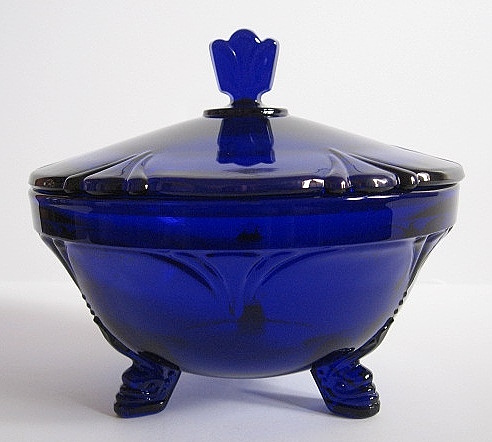
Stiegel Blue (1933-1941) was Heisey’s name for the deep blue color commonly known as “Cobalt.” Heisey named the color in honor of Henry William Stiegel, an 18th century German-American glassmaker who made glassware in vibrant shades of green, purple, and blue. As tastes changed in the 1930s, Stiegel Blue and Tangerine were part of a trend away from pastels and toward deeper, bolder colors.
A complete pressed tableware line was not offered in Stiegel Blue, but all of the No. 1428 Warwick Horn of Plenty items were available in the color. Selected items were made in the Nos. 1401 Empress, 1404 Old Sandwich, 1405 Ipswich, and 1425 Victorian patterns. Stemware with a Cobalt bowl paired with a Crystal stem and foot can be found in the Nos. 419 Sussex, 3390 Carcassonne, 3397 Gascony, 3404 Spanish, and 4044 New Era lines. The Nos. 1415 20th Century, 1417 Arch, and 1460 Flame tumblers were also made in Stiegel Blue.
Many vases of the period, including Nos. 4223 Swirl, 1413 Cathedral, 1420 Tulip, 1421 Hi-Lo, 1433 Thumbprint and Panel, and the 4045 Heron ball vases, were made in Steigel Blue. The No. 1430 Aristocrat low footed and high footed candy jars are particularly desirable in this color, as is the No. 4225 Cobel cocktail shaker.
Zircon, Limelight, and Turquoise
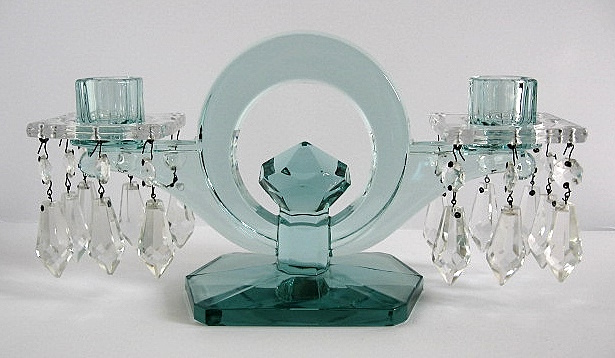
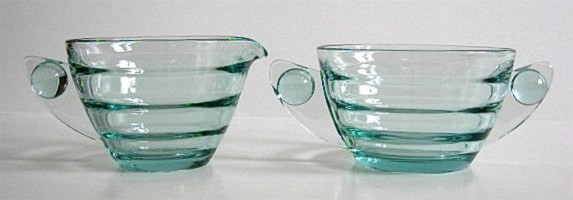
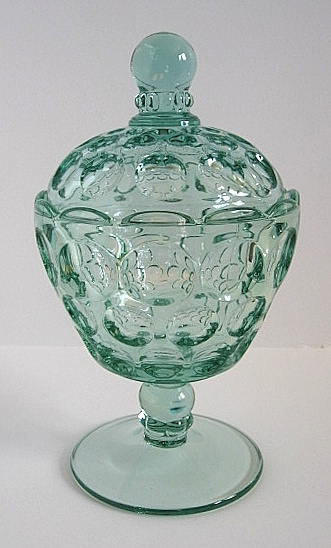
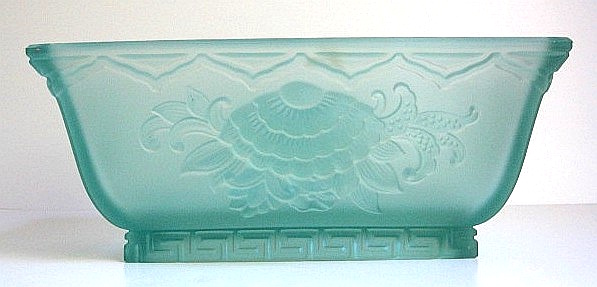
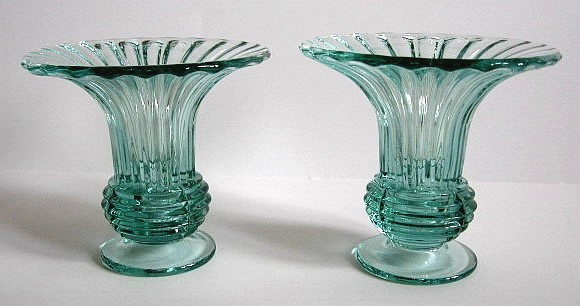
Zircon (1936-1939), Limelight (1955-1957) and Turquoise (c.1956) are three names for the same color, a turquoise blue-green. Advertised as “Heisey’s subtle new color” with “a blue-green pastel tint,” Zircon was introduced in 1936. It was destined to be Heisey’s last production color of the 1920s and ’30s. By the time of Zircon’s introduction, colored glassware was going out of style, and the color apparently was not popular. Zircon was discontinued in 1939.
In 1955, Heisey brought back the blue-green color and gave it its second name, Limelight. The color was still being made when the company closed its doors in 1957. Around the time Limelight was introduced, Heisey was producing glassware in Verlys moulds. The company made some Verlys items in the blue-green color, which they called by its third name, Turquoise.
Heisey consistently described the color as “blue-green” or “turquoise,” but as with other Heisey colors, there are variations. Some collectors consider the earlier production in Zircon to be more on the blue side, and the later production in Limelight to be more on the green side.
In the color’s first appearance, Heisey offered several complete lines in Zircon, including Nos. 1485 Saturn, 1495 Fern, 1488 Kohinoor, and 1506 Whirlpool pressed tableware, and Nos. 4083 Stanhope, 4085 Kohinoor, 4090 Coventry, and 4091 Kimberly stemware. A few items were made in Nos. 1469 Ridgeleigh, 1496 Mahabar (the predecessor of Crystolite), and 4054 Coronation. The No. 4085 ball vase and the No. 4057 Cecelia vase are also known in Zircon.
When the color was reintroduced as Limelight in 1955, it was available in the No. 1485 Saturn and 1506 Provincial (formerly Whirlpool) lines, as well as the No. 5082 Mid- Century stemware pattern. Some pieces in the 1637A Town and Country line, designed by Eva Zeisel, were made in Limelight. Ten items made in the Verlys moulds were offered in Turquoise.
Dawn
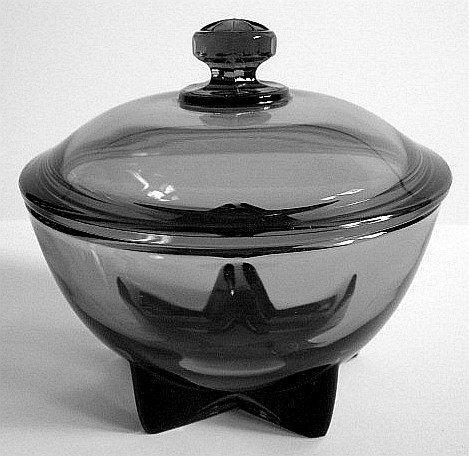
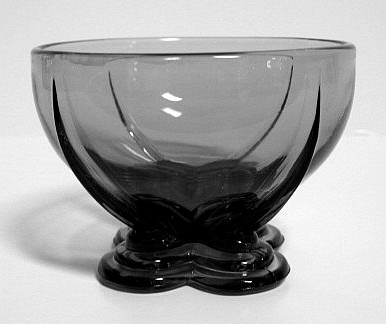
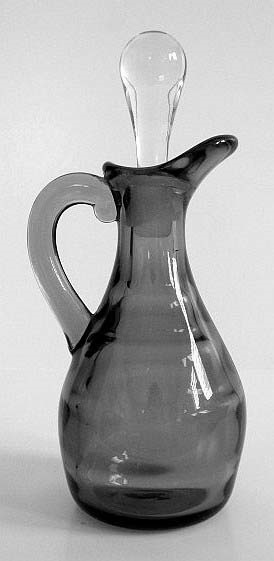
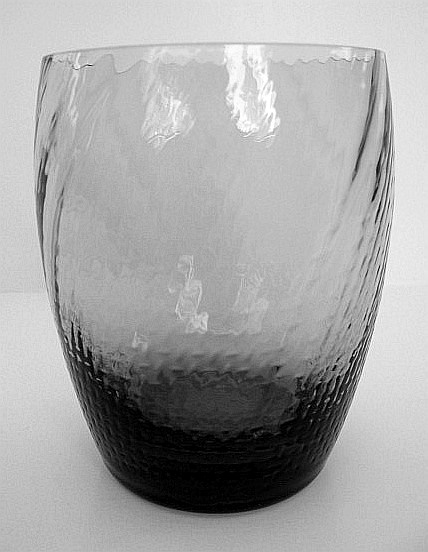
Dawn (1955-1957) was Heisey’s last production color. It is a transparent charcoal or smoke color, apparently inspired by the color of Swedish smoked glass. It was advertised as a “versatile smoke or charcoal color that blends with any color scheme.”
The most commonly-seen item in Dawn is the 1565 Leaf jelly. The patterns most often found in Dawn are Nos. 1632 Lodestar, 1415 Twentieth Century, 1485 Saturn, 1637A Town and Country, and 1951 Cabochon. The Lodestar pattern was made exclusively in Dawn. A blown pattern, No. 6009A Roundelay, was designed by Eva Zeisel and produced primarily in Dawn. The No. 500 Octagon variety tray was made in Dawn. A few pieces in other patterns were also made in Dawn; most are very scarce. Items in the Nos. 6060 Country Club and 4045 Coronation barware lines were made in Dawn with an experimental “screen” optic.
After Heisey ceased operations, Imperial produced the No. 1469 Ridgeleigh cigarette holder, match holder, and square ash tray in Charcoal. Heisey did not produce these items in Dawn. Even if marked with the Diamond H, they are Imperial products. Although Imperial produced items in the Nos. 1632 Lodestar, 1637A Town and Country, and 1951 Cabochon patterns, it did not produce any pieces in these patterns in Charcoal. Any smoke-colored items in these pattern lines should therefore be Heisey products, in Dawn.