Advertising to the Public: 1937-1954 (1960)
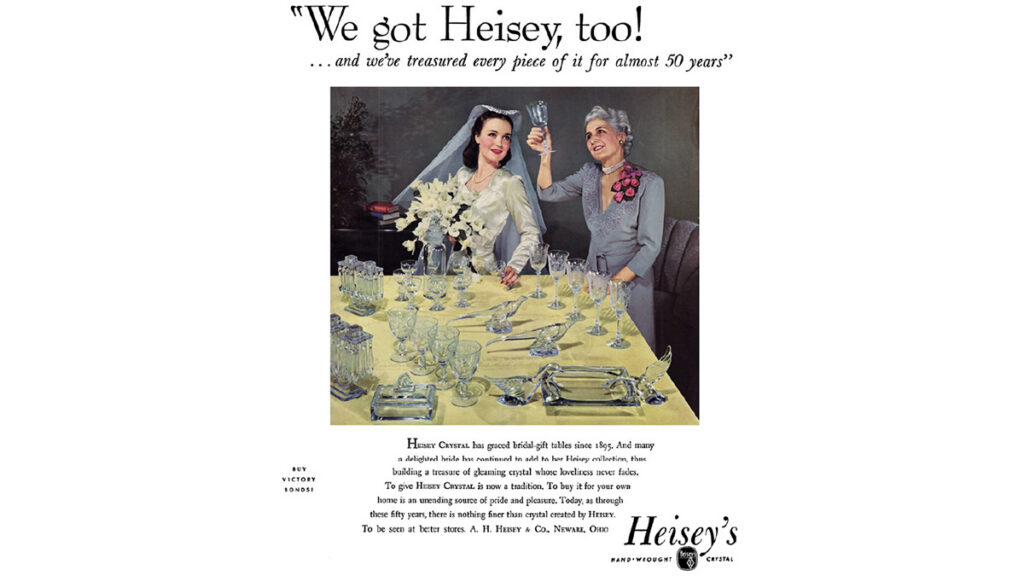
During the final period of public advertising, 184 different ads appeared in 247 placements in 24 publications. Following the exuberance of the color era ad campaigns of 1925-1932 and the hiatus caused by the Great Depression, Heisey advertising focused on the following themes:
- Crystal: Although small amounts of color glassware were made during this period (Cobalt, Zircon/Limelight, Sultana and Dawn), Crystal production predominates.
- Stemware: Forty-one different stemware lines were introduced, including No. 4085 Kohinoor, No. 5010 Symphone, No. 5024 Oxford, No. 5025 Tyrolean, No. 5072 Rose, and No. 5078 Park Avenue.
Patterns: Major pattern lines include No. 1469 Ridgeleigh*, No. 1485 Saturn, No. 1503 Crystolite*, No. 1506 Whirlpool, No. 1509 Queen Ann*, No. 341 Old Williamsburg, No. 1511 Toujours, No. 1519 Waverly*, No. 1540 Lariat*, No. 1567 Plantation*, No. 1590 Zodiac, and No. 1951 Cabochon*. Those patterns marked with an asterisk had matching stemware lines. - Cuttings: Over 200 cuttings decorated the glassware of this period, including No. 890 Churchill, No. 921 Danish Princess, No. 941 Barcelona, No. 944 Courtship, No. 964 Maryland, No. 965 Narcissus, and No. 980 Moonglo. In 1949, some cuttings, such as No. 1015 Dolly Madison Rose, were created to match china patterns manufactured by other companies.
- Etchings: More than 70 etchings were produced during this period, including No. 502 Crinoline, No. 503 Minnet, No. 507 Orchid, No. 515 Heisey Rose and No. 516 Plantation Ivy.
- Figurines: Between 1937 and 1951, 58 items, mostly animals, were produced as table decorations and giftware. Several Heisey animal figurines were featured in the stage (1945) and film (1950) versions of The Glass Menagerie by Tennessee Williams.
Heisey resumed its public advertising in 1937 with a modest series of four ads featuring the recent pattern lines of Ridgeleigh, Kohinoor, Stanhope and Saturn. These appeared in Life and The New Yorker, which had a combined circulation of over 1 million. Although most colors disappeared in the depression, Zircon, which was introduced in 1936, is featured in the Saturn ad.