
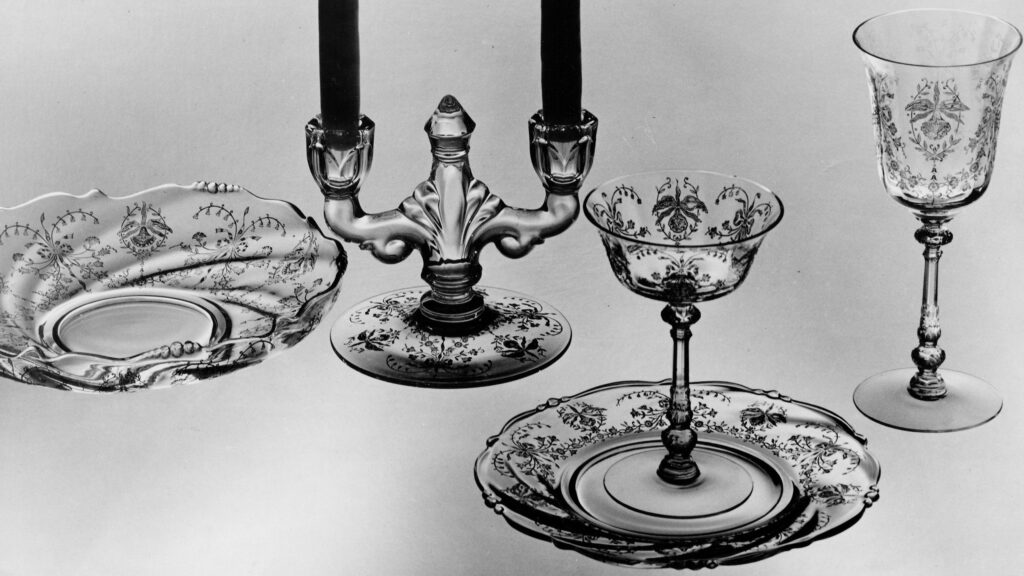
The ethereal beauty of the orchid is captured forever in delicate crystal. Such describes A. H. Heisey & Company’s No. 507 Orchid etching. Introduced in 1940, it gained almost immediate popular acclaim and remained in production until the company ceased operation in 1957 – and beyond. Designed by Ned Newman, this etching features orchid flowers alternating with bows within a framework of vines and small flowers.
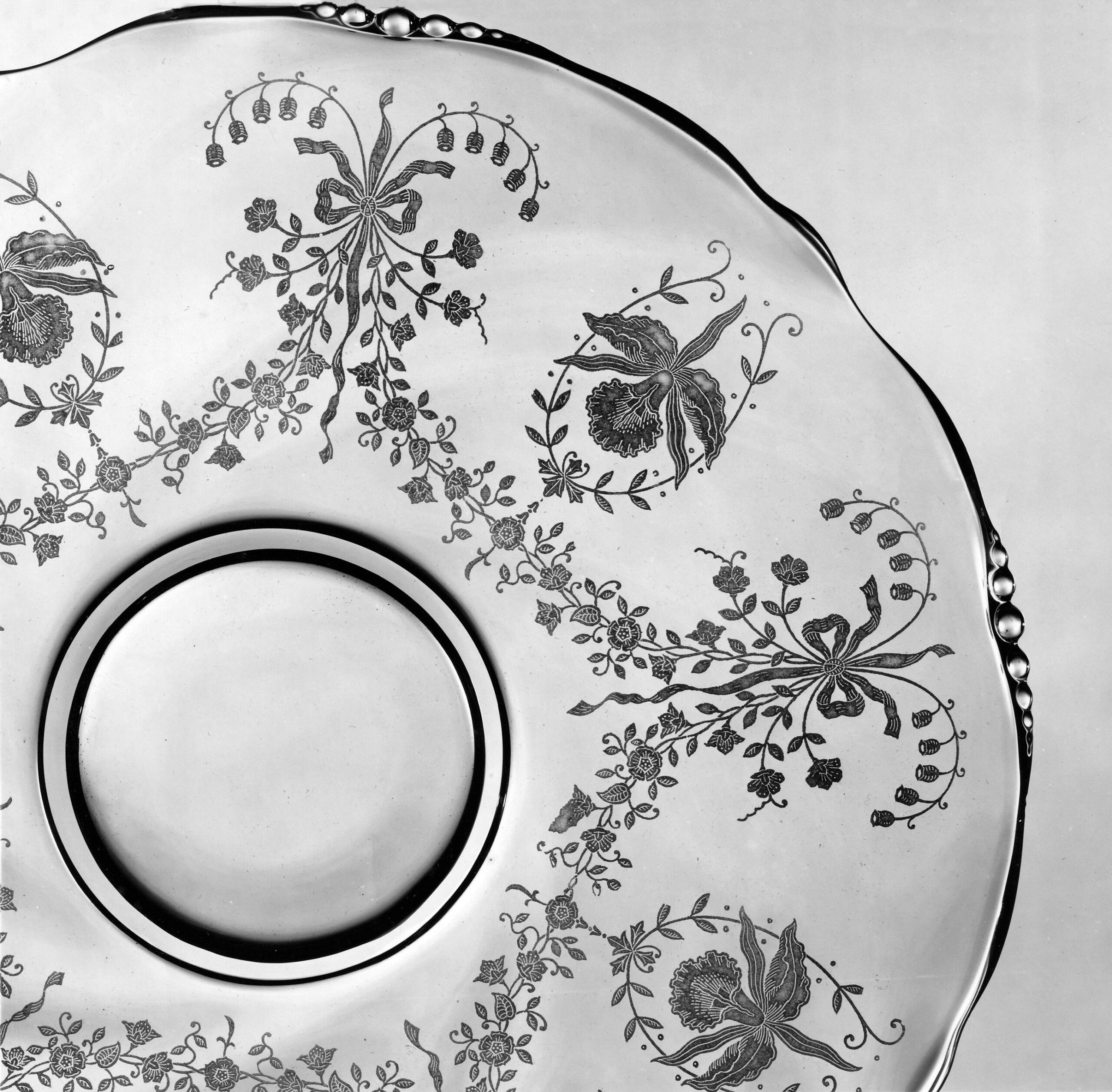
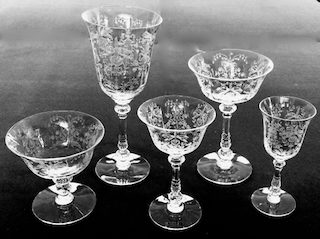
“Orchid was the most popular etching the Heisey Company ever produced and it remains so with collectors today,” wrote Neila Bredehoft in the October 1979 issue of Heisey News, noting that its popularity and long production span “resulted in an unbelievably long list of items available with Orchid etch.”
A widely distributed brochure described the pattern like this: “So fashionable, so delightfully feminine, this lovely Orchid pattern in sparkling hand-wrought crystal by Heisey … rare, jewel-like beauty to highlight the most fastidious table setting … elegance to charm the most discerning guests. For your own smart party occasions or for gifts that delight and surprise, choose Heisey Orchid – available in a complete line of hand-blown stemware, hand-cast table accessories, and decorative utility items.”
According to Bredehoft, author of a booklet on Orchid etching, this glass was released with little fanfare. She speculated that if Heisey had known that Orchid etching would be such a tremendous success it would have promoted the product launch with a massive ad campaign, as it had done for previous lines that had proven less popular. “By April of 1941, the company knew it had a success… Ads praising ORCHID etching began to appear in trade journals and women’s magazines. By 1943, one advertisement called Orchid ‘The most popular etching on the market’.”
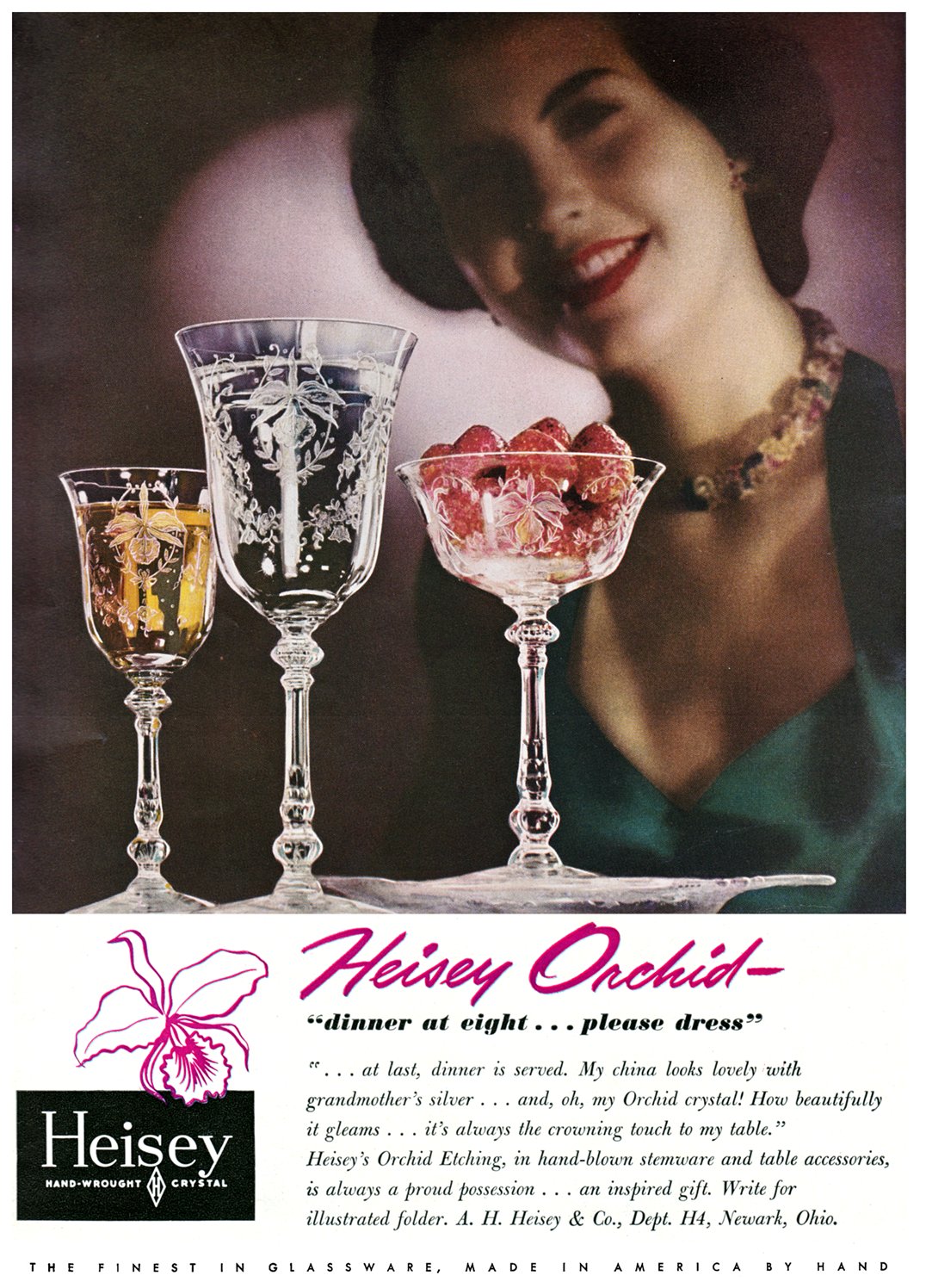
According to Walter Ludwig, Heisey Glass Museum volunteer curator, Orchid etching was the second most popular etching with brides in the 1940s, outsold only by the Rosepoint etching produced by Cambridge Glass Company.
Such was the importance of Orchid etching to Heisey that it was the only pattern or decoration mentioned by name in the introduction to Neila and Tom Bredehoft’s important book, Heisey Glass 1896-1957. “The company pioneered many styles of glassware, colors and decorations while in business. It was second to none in the production of artistic cut tableware, and its Orchid etching was one of the most popular decorations for stemware and tableware ever made in this country.”
Orchid Etching decorated many patterns
While Orchid etching was not introduced until 1940, it decorated some patterns that had been made much earlier, including No. 1187 Yeoman, which originated in 1913. No. 1519 Waverly was introduced the same year as Orchid and was often decorated in Orchid. In fact, when Waverly was reviewed in Crockery & Glass Journal, March 1941, it was inextricably linked with Orchid. “It (Orchid) decorates the swirling Oceanic Pattern (renamed Waverly), a Heisey pattern which wins shoppers’ instant acclaim and gives an air of ‘just rightness’.”
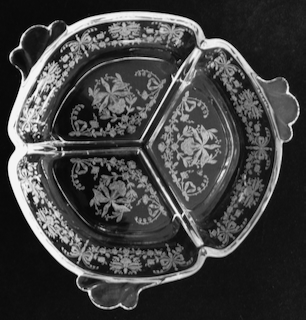
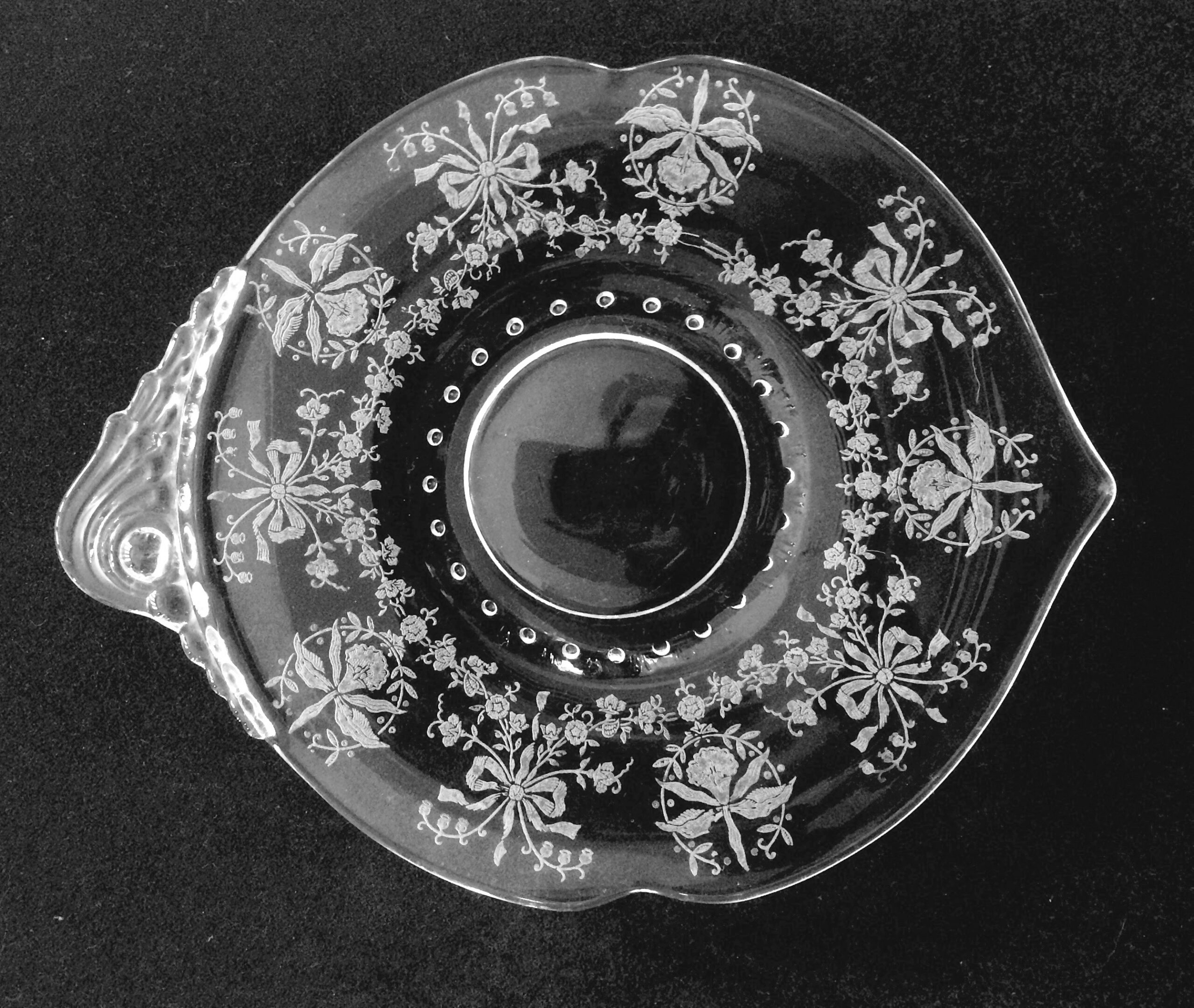
Orchid etching was added to all these pieces:
- 1187 Yeoman (1913 – 1957): footed epergne bowl with vases
- 1489 Puritan (1937 – 1957): cigarette box and cover
- 1495 Fern (1937 – 1941): twin mayonnaise, mayonnaise plate, whipped cream, 3-compartment relish
- 1509 Queen Ann (1938 – 1957): extensive line with various serving plates, relishes, cheese and cracker plate, cup and saucer, dressing bowl, nappies, lemon dish and cover, several floral bowls and more
- 1519 Waverly, originally called Oceanic (1940-1957): extensive line including many specialized serving pieces such as butter dish, comports, various relishes and bowls, jelly dishes, mayonnaise servers, mint bowls, torte and sandwich plates, floral bowls, vases, centerpiece combinations, and more
- 1540 Lariat (1942 – 1957): various vases, two baskets, mayonnaise
- 1951 Cabochon (1951 – 1957): ¼ lb. butter and cover
- 3304 Universal: cocktail icer and liner
- 3311 Velvedere: sherry
- 3389 Duquesne (1930 – 1952): luncheon tumbler
- 3484 Donna: soda/iced tea, ½ gallon ice jug
- 4002 Aqua Caliente (1933 – 1944, 1948 – 1953): cocktail
- 4052 National: soda
- 4090 Coventry (1937 – 1947): sherry and cordial
- 4225 Cobel (1932 – 1957): 1 pt. cocktail shaker, 1 qt. cocktail shaker
- 5012 Urn (1939 – 1957): four sizes of footed bud vases
- 5022 Graceful (1940 – 1943): 12 pieces of stemware plus candy box with cover, dinner bell, finger bowl
- 5025 Tyrolean (1941 – 1957): 12 pieces of stemware plus dinner bell, finger bowl
- 5089 Princess (1952 – 1956): 9 pieces of stemware plus salt and peppers, salad bowl, sandwich plate, torte plate and gardenia bowl
- Numerous candlesticks including No. 134 Trident, No. 142 Cascade, No. 1495 Fern, No. 1502 Crystolite, No. 5009 Queen Ann, No. 1519 Waverly, and several unnamed.
- Many additional pieces in unnamed patterns.
A complete listing is available in the Encyclopedia of Heisey Glassware Etchings and Carvings.
World War II had a significant impact on glass manufacturing in the United States due in large part to a labor shortage. After the war, glass with the Orchid etching remained popular, and the number of items with Orchid etching expanded, especially in the Waverly pattern. Introduced in the early 1950s, the No. 5089 Princess line of stemware featured the Orchid etching but was made for only a few years and is very difficult to find. Bredehoft speculated, “Apparently brides still preferred the tall elegance of the Tyrolean stems.”
Glassware with the Orchid etching remained in production until the Heisey factory closed abruptly in 1957. At that time, Imperial Glass Corporation of Bellaire, Ohio, began producing them. They completed existing orders and actually introduced some new items.
Bredehoft states that it’s difficult, if not impossible, to distinguish between Orchid etched pieces made by Heisey and those made by Imperial. “Imperial was producing crystal of excellent quality at this time and today’s collectors do not differentiate between Heisey Orchid etching or Imperial Orchid etching.” She believed collectors would continue to pursue Orchid etched pieces without regard for the manufacturer.