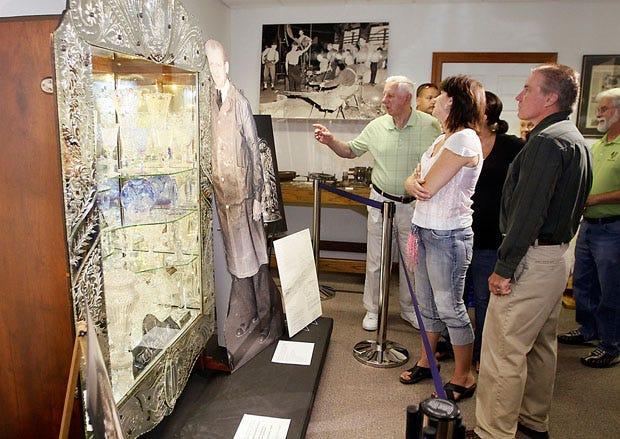
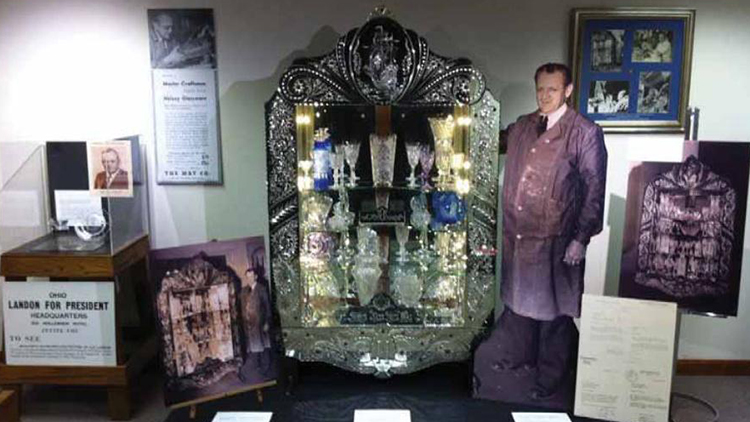
The Alfred M. Landon Frame/Emil J. Krall Exhibition Cabinet was added to the permanent collection of the Heisey Glass Museum in 2011.
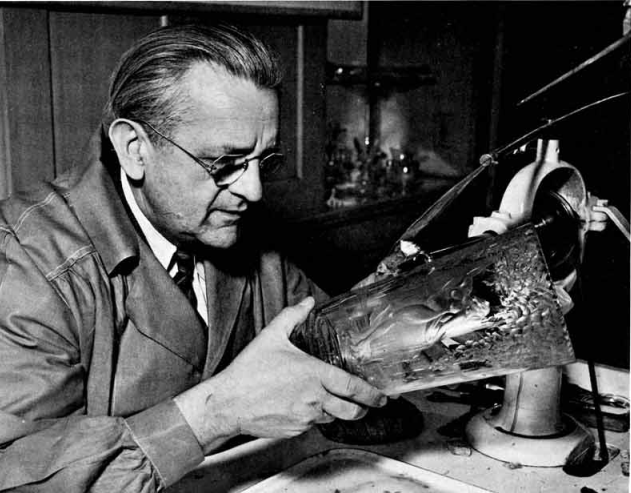
The cabinet features elaborate engravings executed by Emil Krall when he was the head of the cutting department at A.H. Heisey & Company. Krall was born in Bohemia (then part of the Austro-Hungarian Empire) in 1884. After training as a glass cutter and engraver and service at the Austrian royal court, he emigrated to the United States in 1907. Following his arrival in this country, he worked for the Libbey Glass Company and later operated his own glass cutting and engraving studio.
Krall joined A. H. Heisey & Company as head designer and, later, head of the cutting department in 1932. During his tenure at Heisey, Krall designed more than 100 production cuttings and created elaborate engravings for special orders and presentation pieces. Krall left Heisey in the early 1940s and established his own cutting and engraving studio, where he continued to execute his designs on Heisey glassware.
The story of the cabinet begins with the 1936 presidential election campaign of Republican Alf Landon. Wilson Heisey, then president of A.H. Heisey and Company, was chairman of the Ohio for Landon effort. Before the Republican convention, Wilson Heisey enlisted Krall to engrave a large mirror frame to display Landon’s picture at the convention. Krall traveled to Topeka, Kansas, to obtain a likeness of Landon, and then engraved a portrait of him for the top oval of the frame. According to Krall, it took four weeks totaling 480 hours to complete the project. The frame consisted of mirrors engraved with buckeyes and leaves, which were symbols of Ohio, and sunflowers, which was the state flower of Kansas, Landon’s home state.
Once the engravings were completed, it took seven hours to assemble the cut pieces onto the 79″ x 48″ frame. The frame was prominently displayed at the convention, held at the Hollenden Hotel in Cleveland, Ohio. It was to be presented to Landon after he won the election, but Landon lost the election, and the frame was returned to the Heisey company and placed into storage at its factory.
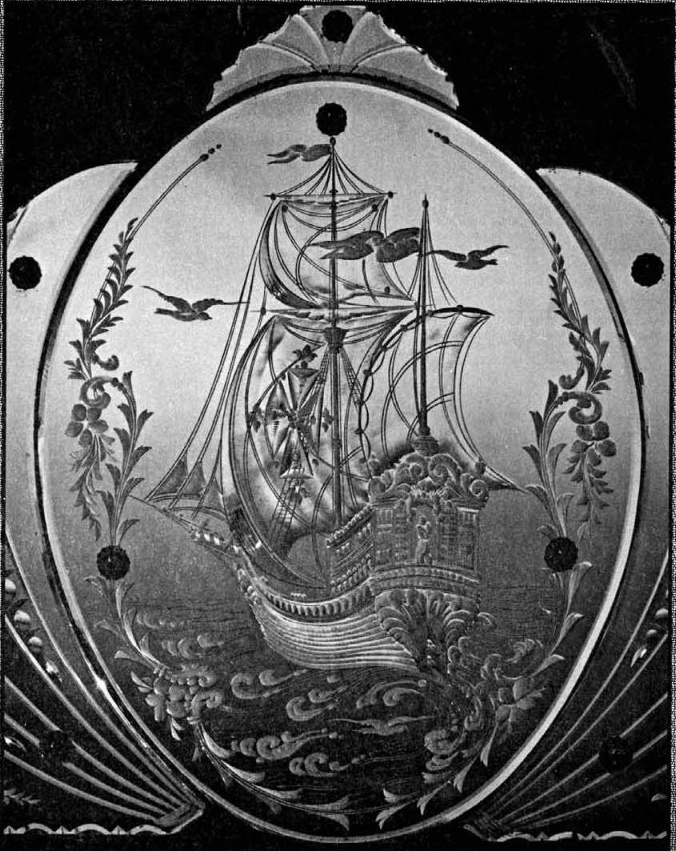
In December 1936, Krall designed a “shadow box” cabinet to display the Landon frame. It was crafted in the wood shop at the Heisey factory. The shelving was glass, and cut Heisey candlesticks were used as supports for the shelves. The center medallion was replaced by Krall with an engraving of the Santa Maria in full sail. The frame was then fixed onto the front of the mirrored cabinet. A special lighting system surrounded the inside of the frame.
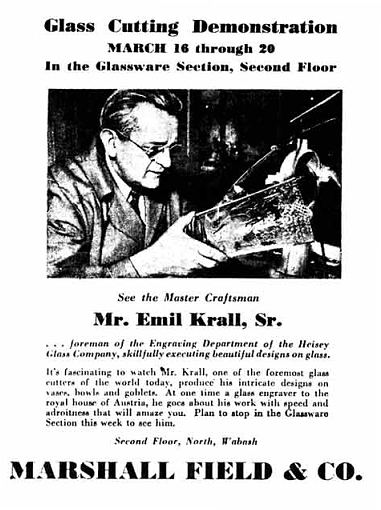
Around this time the Heisey company was making plans for a tour of major department stores around the country to exhibit Krall’s engravings and promote the sale of Heisey glass. The tour included the J. L. Hudson Company, whose flagship store in downtown Detroit was then the tallest department store in the world. Hudson’s agreed to share half of the expenses of Krall’s appearances, which amounted to $100 weekly.
When Krall embarked on the promotional tour, the cabinet accompanied him. In it were displayed special Krall works of art, most one-of-a-kind and obtained by special order only.
Some of the goblets displayed were priced at $1,500 per dozen. According to Tim Heisey, several of the items on display in the cabinet were stolen at a stop in Chicago and never recovered. The cabinet and its contents were insured for $15,000 — a large sum in the midst of the Depression.
Newspaper accounts made much of this insurance, and the resulting publicity played up the value of the glass, along with Krall’s service at the Austrian royal court. During one of these trips, the frame apparently slipped off a hand truck while it was being unloaded and was broken. Krall later designed new mirrors with engravings of flowers for the sides of the cabinet; the engravings were done on glass that was later mirrored (silvered), and the center was one large glass surface.
One of the last appearances of the cabinet under the direction of the Heisey company was in March 1939, when the company in conjunction with the Newark Chamber of Commerce set up a display of the famous “Alfred M. Landon Showcase” that included many of Krall’s one-of-a-kind pieces.
After the Heisey company closed in 1957, the cabinet was sold to Percy Moore. Moore featured it in his antique shop in Kirkersville, Ohio, until it was sold to a collector who moved it to Texas. In the early 1970s, the cabinet’s owners shipped it to Newark, Ohio, where they offered it for sale; however, they were unable to complete a sale, and the cabinet was returned to them.
The cabinet was acquired by the Heisey Glass Museum in 2011. Funding support was provided by The John and Mary Alford Foundation, The Energy Cooperative Round-Up Foundation, and The Rotary Club of Newark-Heath. The Alfred M. Landon Frame/Emil J. Krall Exhibition Cabinet, showcasing many examples of Krall’s work, is now on display in the King House at the Heisey Glass Museum.