
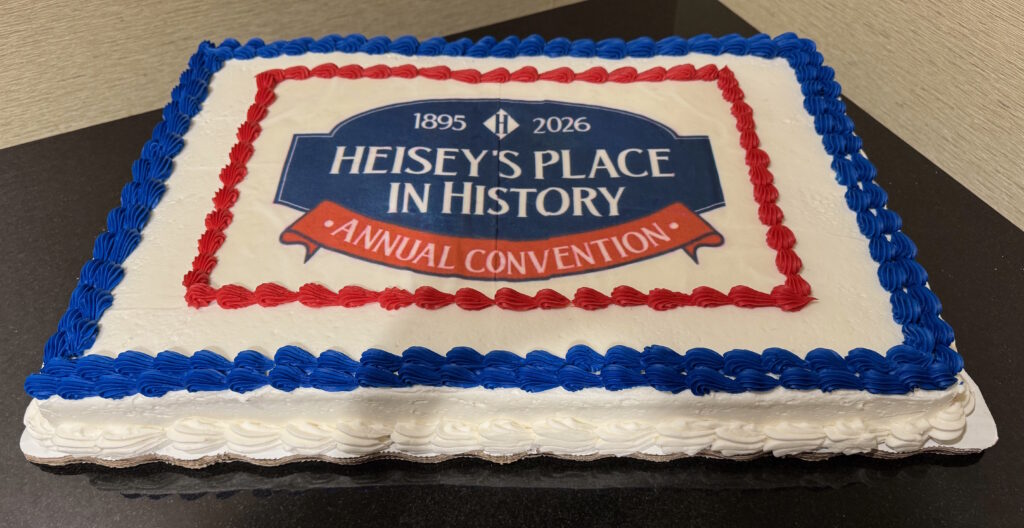
If a time machine had allowed Augustus H. Heisey to visit Newark, Ohio, in 2026 he would probably have been astonished to see the long-lasting impact of the glass company he founded in 1896. Though its fires were extinguished nearly 70 years ago, he would have seen people from across the country gathering to tour the old factory he built, and to buy glass crafted by his employees over its 61-year history. He would have seen people eager to learn more about his glass in seminars, to tour the museum dedicated to preserving that glass, and to simply enjoy the company of others who share the love of all things Heisey.
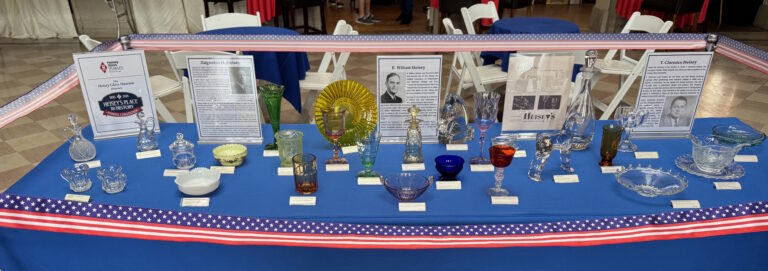
Under the theme Heisey’s Place in History, HCA’s annual convention called attention to the legacy of the Heiseys who headed the factory and the thousands of skilled men and women who created high quality glass in a dazzling array of patterns, colors, and styles.
Welcome Picnic Returns
The convention opened Wednesday evening, June 17, with a Welcome Picnic under a large tent on the lawn between the Buckingham Meeting House and the Sherwood-Davidson House. Owned by the Licking County Historical Society, these buildings, together with the Heisey Glass Museum, share the plot of land known as Veteran’s Park. As HCA members and guests gathered for dinner, Howard Long, historical society executive director, shared information about the fascinating history of the spot, which included a burial mound used by people of the Hopewell culture and a cemetery for early settlers of the Newark area. The picnic included a glass swap, a favorite event of conventions in years past.
Hot Fun with Glassblowing
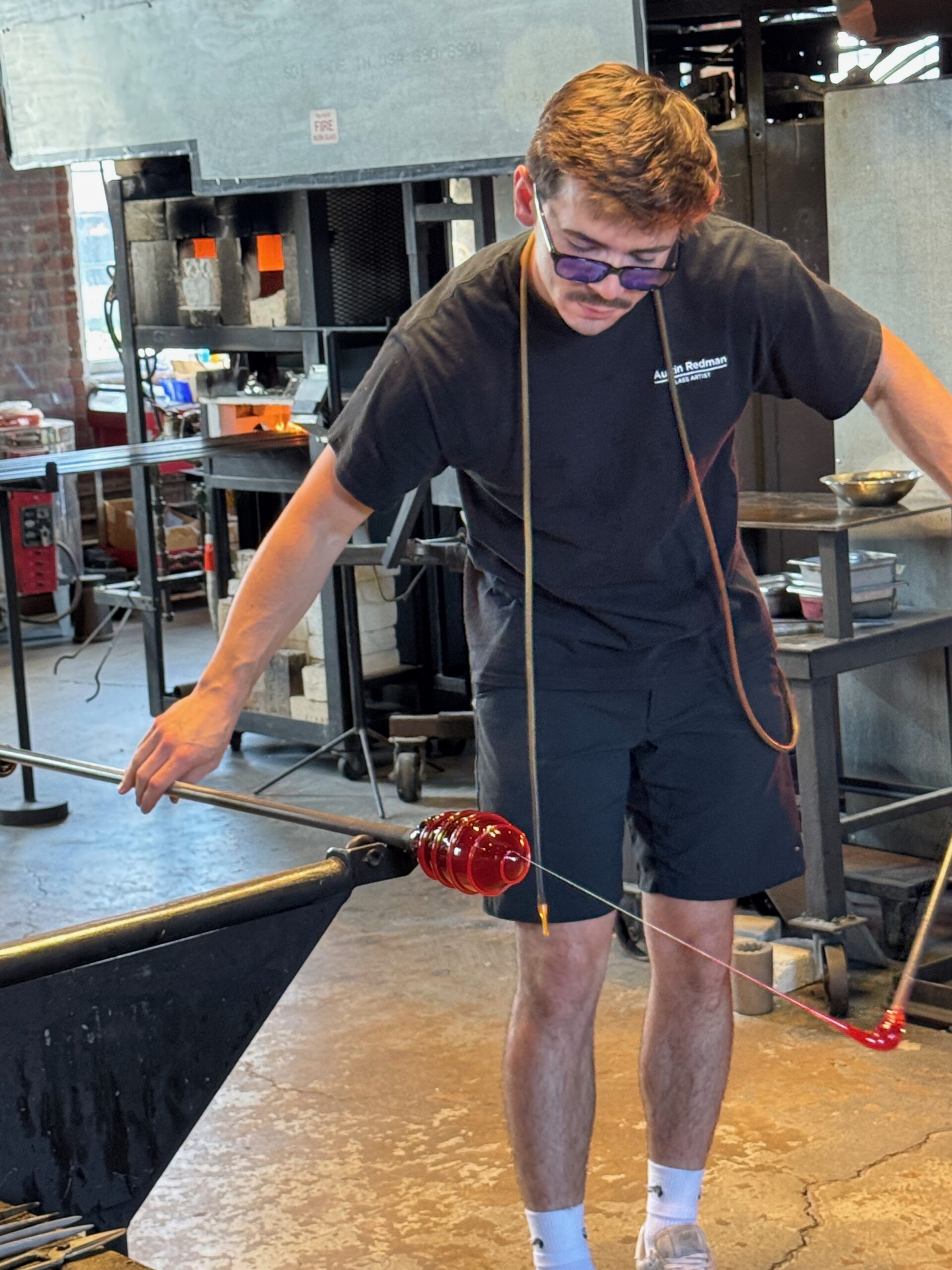
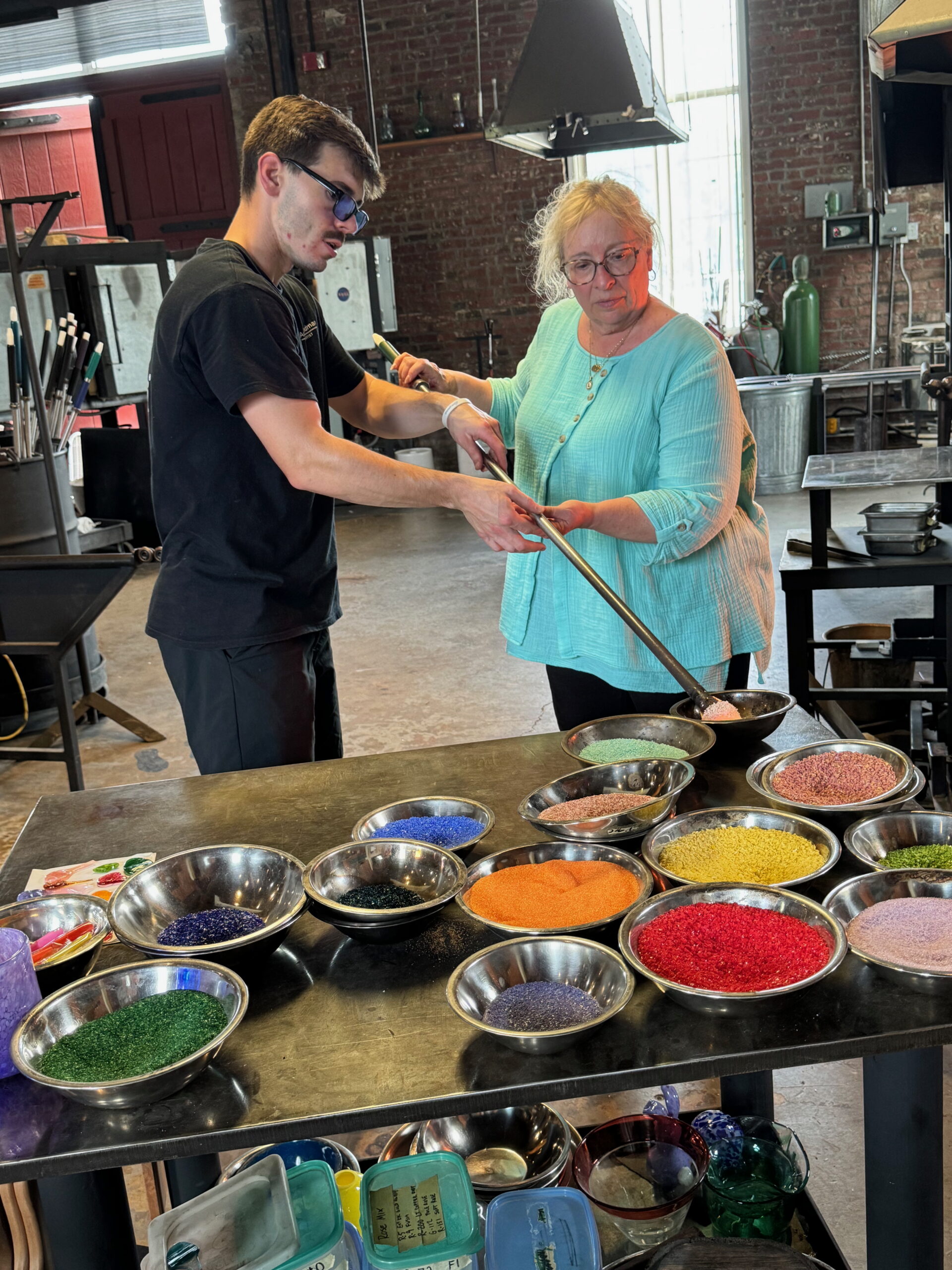
The following day started with options – a Heisey factory tour and two opportunities for members to learn about glassblowing and experience it themselves. The glassblowing activities were held at The Works: Ohio Center for History, Art and Technology, which owes its glass studio to the efforts of HCA.
During a morning demonstration session, Austin Redman, glass studio assistant, fashioned a vase from a glob of molten glass attached to a blow pipe. By blowing into the pipe, he produced a small bubble of air inside the hot glass. He returned it to the glory hole repeatedly to reheat, blowing more air into the glass between each heating, while turning the pipe continuously. The audience watched in amazement as he carefully shaped the glass, attached a punty with a rod to the other end, scored the neck, and then quickly snapped it off the pipe, transferring it to the rod for final shaping.
Later in the day, some participants tried their hand at glassblowing, quickly learning about the extreme heat involved in this art form, the need to pay close attention to rotating the pipe steadily, and the need to observe safety precautions carefully! It was more challenging than it looked!
Heisey Factory Tour
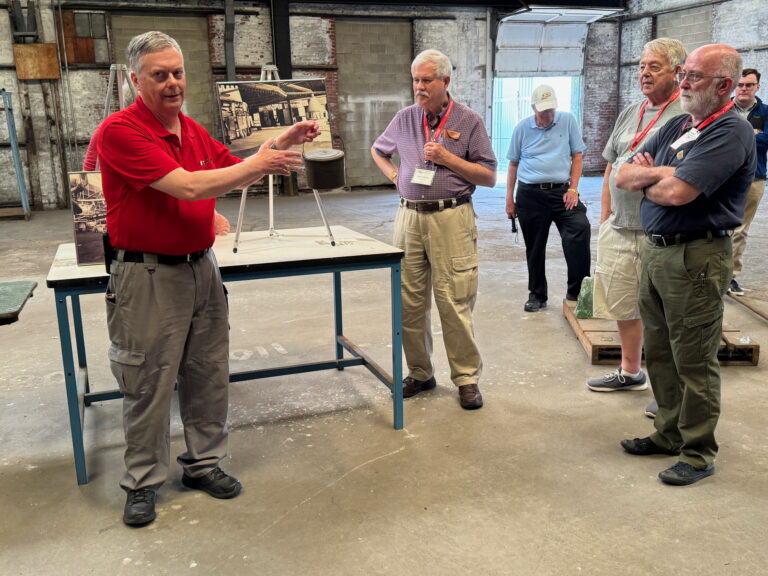
Over on Oakwood Avenue, 20 lucky HCA members were able to tour the historic Heisey factory Thursday afternoon thanks to the generosity of its current owners, Terry and Tracy Hill. The Hills operate Contour Forming, a precision metal fabrication firm, in a portion of the building. They make specialized parts that can be found in MRI machines, submarines and airplanes, and on the moon.
The tour started in the white wood frame building within the factory fence. This modest structure had housed A.H. Heisey & Company offices and the showroom where buyers would have come to see the latest Heisey creations and place orders. The walls of the showroom are still lined with the shelves on which the glass would have been displayed. Several large, mirrored display tables also remain. Tracy explained that light from above would have reflected off the mirrors and up through glass, magnifying its brilliance.
The factory itself is a massive structure, cool and dimly lit. Terry showed the space where one of the factory’s three huge smokestacks had once stood. “They had to be taken down. When the heat was taken from the chimney, it would start disintegrating,” he explained.
The rest of the building was very secure, with some brick walls up to 48 inches thick, perfect for one of its later roles as a bomb shelter. The area housing the furnaces was constructed with arched concrete ceilings and floors. The vast areas housing the cutting and etching departments had wood floors and open ceilings. Exterior brick walls featured large windows to let in maximum natural light. Huge wooden posts supported the structure. “Each post is a quarter sawn tree, most cut from the property to be used in the construction,” he said, noting that wood is superior to steel because steel will buckle and allow structural collapse in a hot fire more quickly than thick wood will burn.
The Hills learned a lot about the operation of the factory and the business from John and Annabelle Campbell, former Heisey employees. John ran the steam engine that powered the plant and Annabelle worked in payroll. They recalled how Augustus Heisey would dance with enthusiasm along with employees when they came to collect their paychecks. The Heiseys also shared positive comments with employees, like a letter from Fred Harvey praising the quality of the Heisey glass he bought to equip his restaurants along railways in the west. It had been posted prominently in the factory for all to read.
A Touch of Glass Gala
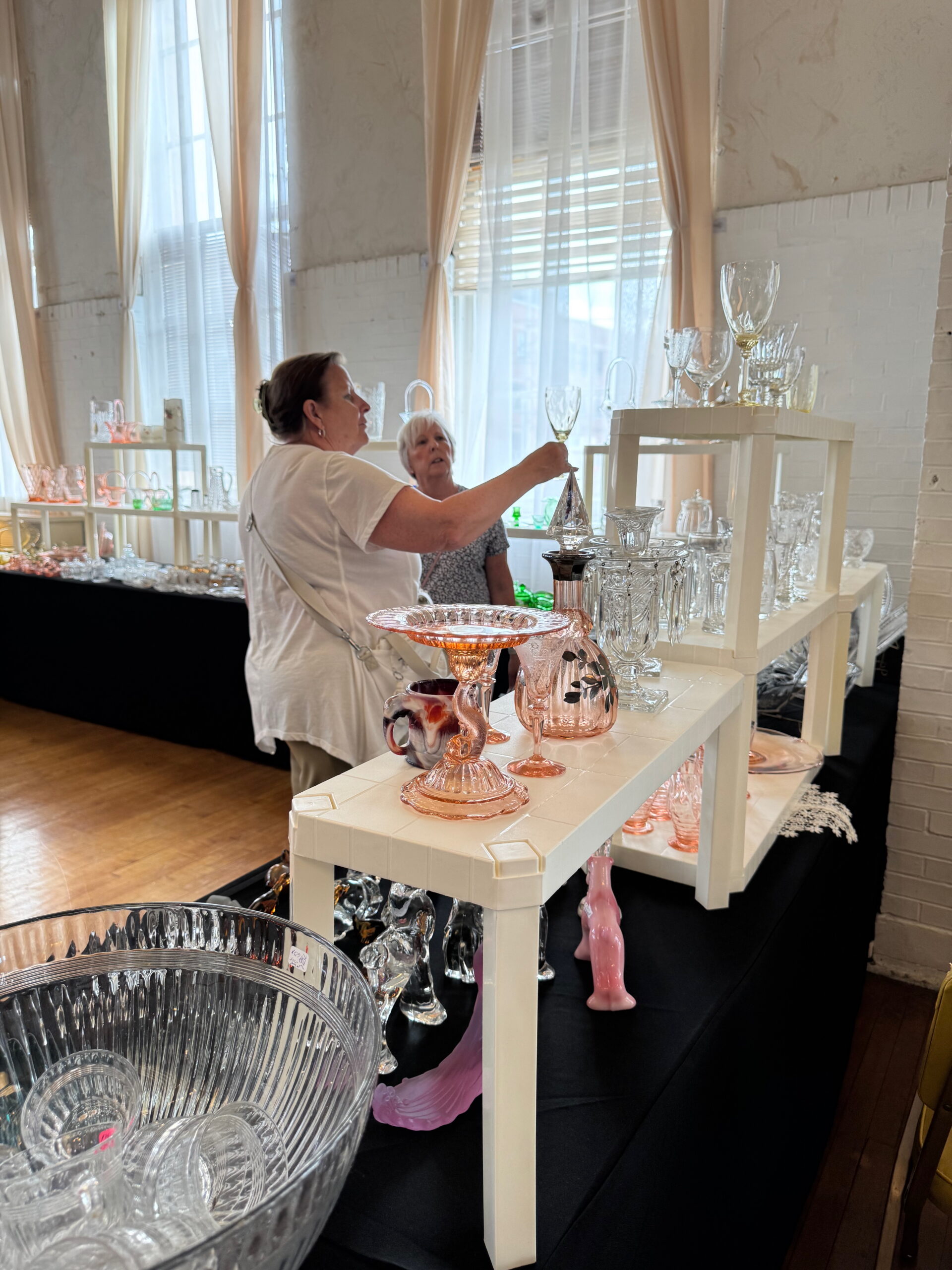
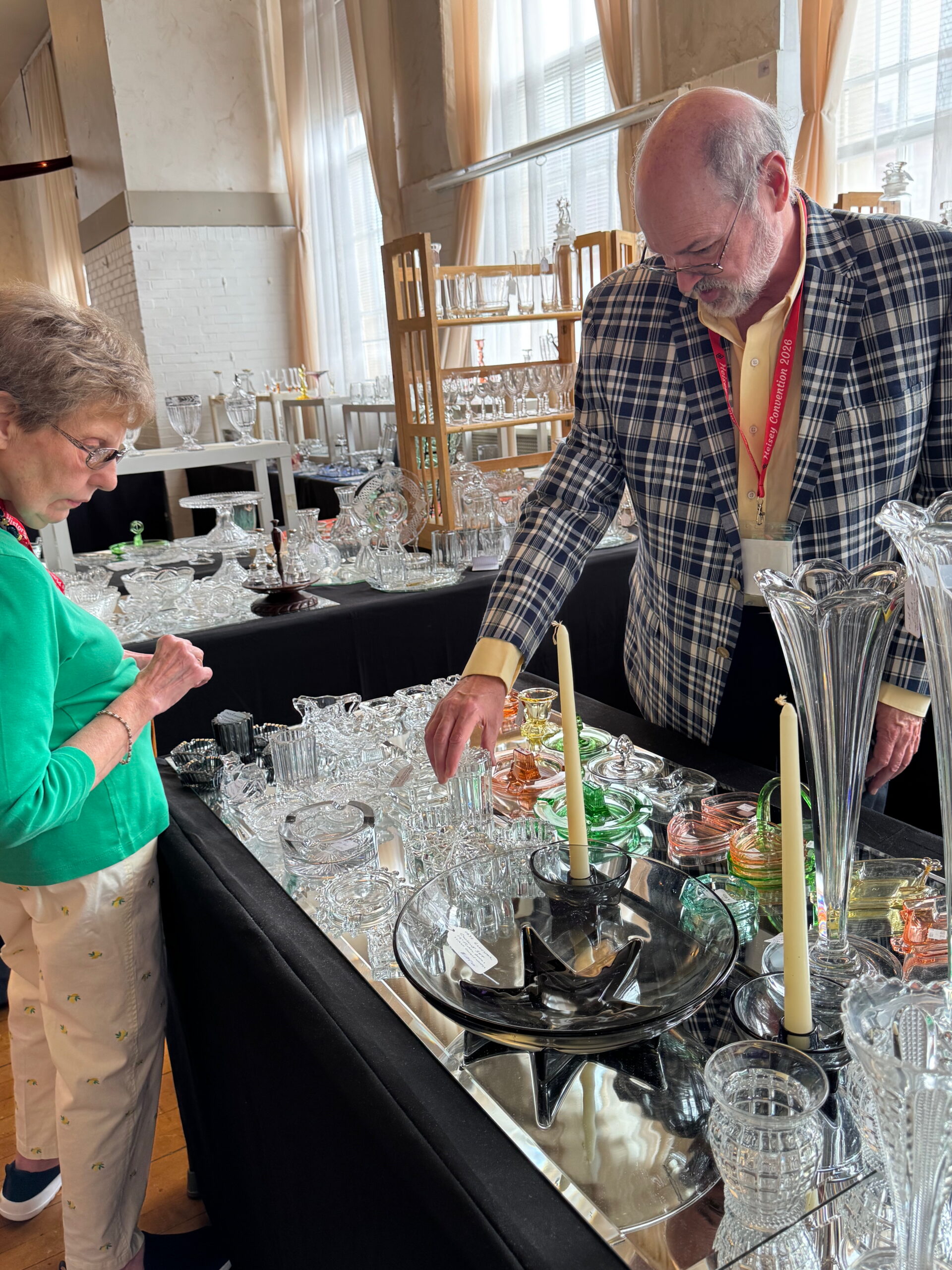
We now move from the quiet majesty of the old factory to the busy spaces of The Skylight event center for the gala opening of A Touch of Glass – the classy glass show and sale where shoppers sipped champagne and sparkling non-alcoholic drinks and sampled an array of hors d’oeuvres and desserts. Volunteers welcomed customers and sold tickets, while dealers busily assisted customers perusing more than 70 tables filled with sparkling glass.
Annual Meeting, Seminars
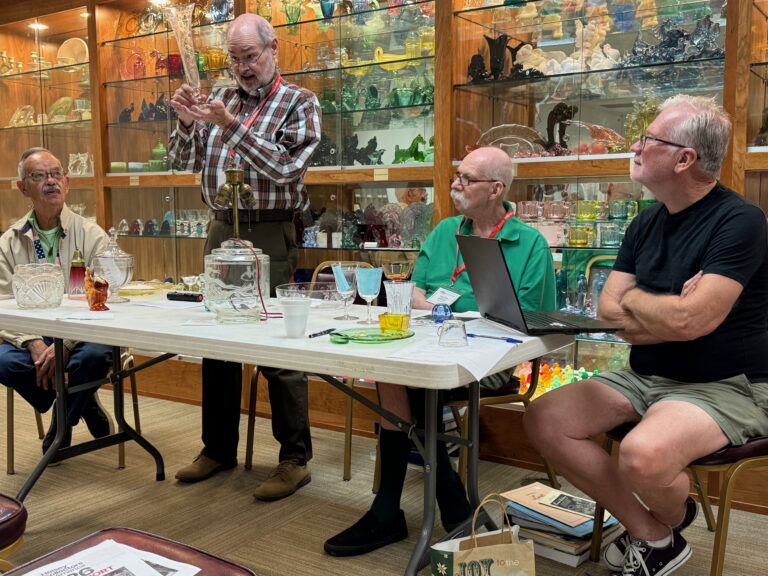
Friday morning started early with the annual meeting, board election, and reports by study clubs. Newly elected board members, Rev. Dr. Doug Meister, Prairie Aster Obora, and incumbent Eric Tankesley-Clarke, recited the oath of office.
Next up was a glass identification session dubbed Mystify the Masters, with experts Walter Ludwig, John Martinez, Eric Tankesley-Clarke, and Lynn Welker. Participants had brought a number of items – Heisey and non-Heisey– to be identified. Emily Sanderell, HCA’s new collections manager, introduced the panel and also identified a couple of interesting pieces.
Three seminars followed over at the glass show. In Through the Looking Glass of an Edwardian Dinner Party, Lori Stillman gave an overview of all the elements needed to pull off a 13-course formal dinner party for 10 guests in 1902, starting with the written invitation. During the approximately four-hour dinner, guests would have used 296 pieces of Heisey glass and 771 pieces of china and silver. “And that doesn’t include the pots and pans!” said Lori, who reminded the audience that the kitchen was probably equipped with just a pump for water and a wood-burning stove to heat it.
Tom Files shared a number of unusual or hard-to-find creams and sugars in his seminar, Heisey’s Creams (and Sugars) of the Crop. Heisey produced 110 patterns that included creams and sugars. If you add in the extras in some patterns – individual size and hotel size – there are over 200 sets of creams and sugars, and if you include those decorated with cuttings and etchings, the number tops 300.
In Heisey’s Overlooked Jewels, Mary Olson explained the delights of collecting Heisey mustard pots. Heisey produced about 35 different mustards, though a couple may have been originally considered horseradish jars. They are great to collect because they are small and manageable – compared with a punch bowl collection – and, even though the pieces are small, there is a great deal of style variation and detail to ponder.
Banquet
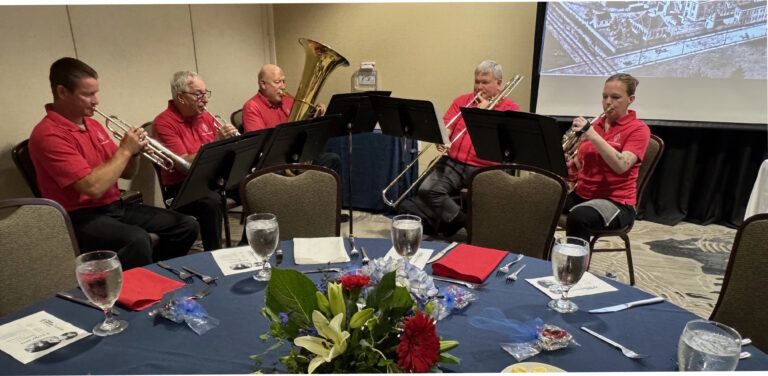
Guests to the Friday evening banquet were welcomed with music from the Heisey Brass Quintet, a small performance group of the Heisey Wind Ensemble. Formed in 1985 with local professional musicians, the ensemble chose the name Heisey because of its association in Newark with high quality.
Following the dinner, Howard Long gave an illustrated presentation on how A.H. Heisey & Company impacted Newark economically and culturally. According to Long, Heisey employees were a huge part of the community’s identity, “Skilled craftsmen like Emil Krall improved the artistic quality of Heisey glass through detailed engraving, Ray Cobel, known as the ‘Master Mechanic,’ helped keep the factory running smoothly and trained other workers,” he said. “Even everyday workers like John Henry Holman, who started working at age 12, show how Heisey became a multigenerational employer that shaped entire families and built long-term community stability.
“Heisey was more than just a factory. It was a major employer, a cultural symbol, and a source of pride for Newark. It connected ancient glassmaking traditions, local industry, and national recognition into one legacy that still represents the importance of craftmanship and community today.”
Auctioneer Craig Connelly finished out the evening with an auction of fabulous glass and gift baskets donated by individuals and Heisey study clubs. Together the convention’s live and silent auctions raised more than $8,000 to support the museum.
Flea Market Fun, Final Seminars
Saturday morning started with the traditional glass flea market in the Canal Market District and a long-standing favorite of children and the young at heart – the Dime Toss game in which competitors try to toss dimes into glassware arrayed on a table and underneath in a wading pool.
Then it was back to The Skylight for the final day of the glass show and two more seminars. Eric Tankesley-Clarke presented Heisey’s Adventures into Bent Glass and Other Mid-Century Modern Styles. He showed some of the simple, streamlined patterns of the 1940s and 1950s that fit the Mid Century Modern aesthetic with its lack of ornamentation. He also shared an interesting series of letters between a Heisey salesman, Joe Lower, and Harold Dunham, director of sales. The salesman pointed out in letter after letter that “bent glass” designs were becoming very popular with the public; buyers for stores were asking for them.
Bent glass starts with a flat sheet of glass, which is then modified by heating and bending. Heisey did not have the capacity to produce bent glass at the time – it produced only blown and pressed glass styles. After several years of pleading, however, Heisey decided to try bent glass and bought a number of flat sheets of glass in several colors, presumably with the intent of modifying them to produce bent styles. The year was 1956, just a year before Heisey went out of business, and records show that only a few dozen clear glass 8” x 14” trays with No. 516 Plantation Ivy were made. Eric asks that anyone who comes across a piece of bent glass with Plantation Ivy should buy it and then contact him!
Karen Taylo presented the last seminar, a very useful session on Navigating the Archives. She explained how to find the thousands of Heisey photos, catalogs, price lists, advertisements, brochures, and other company records. These items are all available on SharePoint, accessible through the Heisey website in the Research section under the Education tab. As more items are digitized, they are added to SharePoint.
The convention ended with an unusual surprise. Dozens of wrestlers and fans converged on The Skylight and began setting up a wrestling ring for a competition as dealers packed their remaining glass!
Thanks to the Convention Committee members for their enthusiasm, time, talent, and attention to detail: Lisa Baldus and Kelly Thran, glass show co-chairs; Bari Fauss, Caleb-Michael Files, Julie Goletz, Jenny Higbee, Jennifer Miller, Cheryl Varrasso, Amy Whitcraft, and Mary Olson, chair.
Mark your calendar for 2027! The HCA board has already approved the dates – June 16 through 19.